

Tutorial 07 — Ligands and parameter files#

Load ligand chemistry, inspect a .tmol parameter bundle, score a protein–ligand complex, and refine its pocket. Assumes scoring, packing, and minimization.
Setup#
In Colab, select T4 GPU, then Run all. For local execution, follow the installation guide. Setup installs TMol and downloads the fixtures on first use.
The tutorial uses checked-in structures and parameter files. Colab downloads these fixtures during setup; the calculations do not query a live structure database. It keeps two chemistry paths separate: a pinned ADA/LG1 protein–ligand complex for scoring and refinement, and an independent AMPC MOL2 preparation example for inspecting generated parameters.
[1]:
try:
    import google.colab  # noqa: F401
except ImportError:
    IN_COLAB = False
else:
    IN_COLAB = True

if IN_COLAB:
    from urllib.request import urlopen

    exec(
        urlopen(
            "https://raw.githubusercontent.com/uw-ipd/tmol/"
            "master/docs/tutorial/colab_setup.py"
        ).read(),
        globals(),
    )
    setup_colab(
        [
            "tmol/tests/data/protein_ligand_test/ada.xtal-lig.mmff94.tmol",
            "tmol/tests/data/protein_ligand_test/ada.tmol.nomin.cif",
            "tmol/tests/data/ligand_test/ligand_ground_truth/mol2/ampc_1.mol2",
        ]
    )
[2]:
from contextlib import redirect_stderr, redirect_stdout
from io import StringIO
from pathlib import Path
import tempfile
import warnings

import attrs
import biotite.structure as struc
import biotite.structure.io
import matplotlib.pyplot as plt
import numpy as np
import pandas as pd
import torch
import yaml
from IPython.display import display

import tmol
from tmol.database import ParameterDatabase
from tmol.io import build_context_from_biotite, pose_stack_from_biotite
from tmol.ligand import (
    inject_params_file,
    load_params_file,
    nonstandard_residue_info_from_mol2,
    prepare_single_ligand,
    write_params_file,
)
from tmol.ops import (
    build_coord_mask_for_mask_and_interacting_atoms,
    calculate_block_pair_ddg,
    compute_block_adjacency,
    compute_block_centroids_and_furthest_dist,
)
from tmol.score import beta2016_score_function

SEED = 20260807
np.random.seed(SEED)
torch.manual_seed(SEED)
warnings.filterwarnings(
    "ignore", message=r"Sparse invariant checks are implicitly disabled.*"
)
device = (
    torch.device("cuda", torch.cuda.current_device())
    if torch.cuda.is_available()
    else torch.device("cpu")
)
LIGAND_RES_NAME = "LG1"


def show_table(frame):
    try:
        from itables import show
    except ImportError:
        return display(frame)
    return show(frame)


def ligand_block_mask(pose_stack):
    mask = torch.zeros_like(pose_stack.block_type_ind, dtype=torch.bool)
    for pose_i in range(pose_stack.n_poses):
        for block_i in range(pose_stack.max_n_blocks):
            type_i = int(pose_stack.block_type_ind[pose_i, block_i])
            if type_i < 0:
                continue
            block_type = pose_stack.packed_block_types.active_block_types[type_i]
            mask[pose_i, block_i] = block_type.name3 == LIGAND_RES_NAME
    if not bool(mask.any()):
        raise RuntimeError(f"No {LIGAND_RES_NAME} ligand block was built")
    return mask
Environment variable CCD_MIRROR_PATH not set. Will not be able to use function requiring this variable. To set it you may:
  (1) add the line 'export VAR_NAME=path/to/variable' to your .bashrc or .zshrc file
  (2) set it in your current shell with 'export VAR_NAME=path/to/variable'
  (3) write it to a .env file in the root of the atomworks.io repository
Environment variable PDB_MIRROR_PATH not set. Will not be able to use function requiring this variable. To set it you may:
  (1) add the line 'export VAR_NAME=path/to/variable' to your .bashrc or .zshrc file
  (2) set it in your current shell with 'export VAR_NAME=path/to/variable'
  (3) write it to a .env file in the root of the atomworks.io repository
The .tmol parameter bundle#
Prefer mmCIF/CIF for structure input, especially for protein–ligand systems: CIF chemical-component and bond tables can preserve connectivity and bond order that PDB coordinate records do not reliably encode. Retain MOL2 or prepared .tmol chemistry when it is the authoritative ligand source; a coordinate-only conversion cannot recover missing bond orders.
TMol’s portable .tmol file is versioned YAML with three top-level payloads:
chemical: residue atoms, bonds, internal coordinates, torsions, and properties;elec: per-atom partial charges; andcartbonded: residue-specific bonded parameters.
The same schemas are split across TMol’s canonical database files at tmol/database/default/chemical/chemical.yaml, tmol/database/default/scoring/elec.yaml, and tmol/database/default/scoring/cartbonded.yaml. A portable .tmol file bundles ligand additions to those three domains; chemical.yaml alone is not a complete scoring parameter set.
[3]:
repo_root = Path.cwd()
if not (
    repo_root / "tmol/tests/data/protein_ligand_test/ada.tmol.nomin.cif"
).exists():
    repo_root = Path(tmol.__file__).resolve().parents[1]
data_dir = repo_root / "tmol" / "tests" / "data" / "protein_ligand_test"
reference_tmol = data_dir / "ada.xtal-lig.mmff94.tmol"
complex_cif = data_dir / "ada.tmol.nomin.cif"
ligand_mol2 = (
    repo_root
    / "tmol"
    / "tests"
    / "data"
    / "ligand_test"
    / "ligand_ground_truth"
    / "mol2"
    / "ampc_1.mol2"
)

# This is the pinned ADA/LG1 preparation used by the complex below. The later
# AMPC MOL2 preparation is an independent pipeline demonstration.
preparation = load_params_file(reference_tmol)[0]
work_dir = Path(tempfile.mkdtemp(prefix="tmol-ligand-tutorial-"))
tmol_path = work_dir / "LG1.tmol"
write_params_file(preparation, tmol_path)

print("Wrote:", tmol_path)
Wrote: /tmp/tmol-ligand-tutorial-x0evhkzd/LG1.tmol
Verify the parameter round trip#
The reloaded .tmol bundle must reproduce atom names, types, partial charges, and all three payloads. TMol supports this parameter format only.
[4]:
tmol_document = yaml.safe_load(tmol_path.read_text())

print("TMol .tmol excerpt")
print("\n".join(tmol_path.read_text().splitlines()[:18]))
print("\nTop-level payloads:", sorted(tmol_document))
print("Format version:", tmol_document["version"])

reloaded = load_params_file(tmol_path)[0]
ada_atom_frame = pd.DataFrame(
    [
        {
            "atom": atom.name,
            "TMol_atom_type": atom.atom_type,
            "pinned_partial_charge": preparation.partial_charges[atom.name],
            "reloaded_partial_charge": reloaded.partial_charges[atom.name],
            "provenance": "pinned ada.xtal-lig.mmff94.tmol",
        }
        for atom in preparation.residue_type.atoms
    ]
)
show_table(ada_atom_frame)

assert reloaded.residue_type.atoms == preparation.residue_type.atoms
assert reloaded.residue_type.bonds == preparation.residue_type.bonds
assert reloaded.partial_charges == preparation.partial_charges
print("\nRound trip preserved atoms, bonds, and charges.")
TMol .tmol excerpt
version: '5.2'
chemical:
  residues:
  - name: LG1
    base_name: LG1
    name3: LG1
    io_equiv_class: LG1
    atoms:
    - {name: C1, atom_type: CR}
    - {name: N1, atom_type: Nad3}
    - {name: C2, atom_type: CR}
    - {name: N2, atom_type: Nim}
    - {name: C3, atom_type: CR}
    - {name: C4, atom_type: CDp}
    - {name: O1, atom_type: Oad}
    - {name: N3, atom_type: Nad}
    - {name: C5, atom_type: CS1}
    - {name: C6, atom_type: CSp}

Top-level payloads: ['cartbonded', 'chemical', 'elec', 'version']
Format version: 5.2
| Loading ITables v2.9.1 from the internet... (need help?) |
| ⓘatom | TMol_atom_type | pinned_partial_charge | reloaded_partial_charge | provenance |
|---|---|---|---|---|
| C1 | CR | -0.302 | -0.302 | pinned ada.xtal-lig.mmff94.tmol |
| N1 | Nad3 | 0.048 | 0.048 | pinned ada.xtal-lig.mmff94.tmol |
| C2 | CR | 0.036 | 0.036 | pinned ada.xtal-lig.mmff94.tmol |
| N2 | Nim | -0.565 | -0.565 | pinned ada.xtal-lig.mmff94.tmol |
| C3 | CR | 0.141 | 0.141 | pinned ada.xtal-lig.mmff94.tmol |
| C4 | CDp | 0.716 | 0.716 | pinned ada.xtal-lig.mmff94.tmol |
| O1 | Oad | -0.570 | -0.570 | pinned ada.xtal-lig.mmff94.tmol |
| N3 | Nad | -0.800 | -0.800 | pinned ada.xtal-lig.mmff94.tmol |
| C5 | CS1 | 0.256 | 0.256 | pinned ada.xtal-lig.mmff94.tmol |
| C6 | CSp | 0.280 | 0.280 | pinned ada.xtal-lig.mmff94.tmol |
| (26 more rows not shown) | ||||
Round trip preserved atoms, bonds, and charges.
Prepare AMPC from MOL2#
Read the checked-in AMPC MOL2, containing explicit hydrogens, Tripos bond types, formal-charge annotations, and MMFF94 partial charges. res_name="AMP" names the new residue. This separate example neither regenerates nor scores the unrelated ADA/LG1 fixture. It needs no network request or stochastic conformer generation.
AMPC’s formal charge is −1; its partial charges should sum to approximately −1 at MOL2 precision. properties.protonation.protonation_state is packing metadata, not a formal-charge calculation. A "neutral" value must not override the source chemistry.
Coordinates alone do not establish reliable bond orders or charges. Preserve authoritative chemistry throughout preparation.
[5]:
mol2_text = ligand_mol2.read_text()
assert "MMFF94_CHARGES" in mol2_text.splitlines()[:10]
assert "charge -1" in mol2_text

mol2_info = nonstandard_residue_info_from_mol2(ligand_mol2, res_name="AMP")
if mol2_info.partial_charges is None:
    raise RuntimeError("AMPC MOL2 did not expose authoritative partial charges")

# Preserve the authoritative MOL2 records before preparation. Hydrogen names may
# be regenerated, while charge transfer remains index-based.
source_atom_names = tuple(mol2_info.atom_names)
source_elements = tuple(mol2_info.elements)
source_subtypes = tuple(mol2_info.atom_array.tmol_source_subtype)
source_partial_charges = dict(mol2_info.partial_charges)

generated_preparation = prepare_single_ligand(mol2_info)
generated_tmol_path = work_dir / "AMPC.generated.tmol"
write_params_file(generated_preparation, generated_tmol_path)

def mol2_unity_atom_formal_charges(text, atom_names):
    """Read explicit per-atom formal charges from a TRIPOS MOL2 block."""
    lines = [line.strip() for line in text.splitlines()]
    try:
        line_index = lines.index("@<TRIPOS>UNITY_ATOM_ATTR") + 1
    except ValueError as error:
        raise RuntimeError("MOL2 has no UNITY_ATOM_ATTR formal charges") from error
    charges = {name: 0 for name in atom_names}
    while line_index < len(lines) and not lines[line_index].startswith("@<TRIPOS>"):
        if not lines[line_index]:
            line_index += 1
            continue
        atom_id, attribute_count = map(
            int, lines[line_index].split()[:2]
        )
        line_index += 1
        for _ in range(attribute_count):
            attribute, value = lines[line_index].split()[:2]
            line_index += 1
            if attribute == "charge":
                charges[atom_names[atom_id - 1]] = int(value)
    return charges


source_formal_charges = mol2_unity_atom_formal_charges(
    mol2_text, source_atom_names
)
source_formal_charge = sum(source_formal_charges.values())
source_partial_charge_sum = float(sum(source_partial_charges.values()))
generated_partial_charge_sum = float(
    sum(generated_preparation.partial_charges.values())
)
generic_protonation_metadata = (
    generated_preparation.residue_type.properties.protonation.protonation_state
)
assert source_formal_charge == -1
assert np.isclose(source_partial_charge_sum, -1.0, atol=5e-4)
assert np.isclose(
    generated_partial_charge_sum, source_partial_charge_sum, atol=1e-8
)

generated_atoms = tuple(generated_preparation.residue_type.atoms)
assert len(generated_atoms) == len(source_atom_names)
source_charge_vector = [source_partial_charges[name] for name in source_atom_names]
generated_charge_vector = [
    generated_preparation.partial_charges[atom.name] for atom in generated_atoms
]
assert np.allclose(generated_charge_vector, source_charge_vector, atol=1e-8)
ampc_atom_frame = pd.DataFrame(
    [
        {
            "source_atom": source_name,
            "generated_atom": generated_atom.name,
            "element": element,
            "source_Tripos_subtype": subtype,
            "source_formal_charge": source_formal_charges[source_name],
            "source_MMFF94_partial_charge": source_partial_charges[source_name],
            "generated_TMol_atom_type": generated_atom.atom_type,
            "generated_partial_charge": generated_preparation.partial_charges[
                generated_atom.name
            ],
        }
        for source_name, element, subtype, generated_atom in zip(
            source_atom_names,
            source_elements,
            source_subtypes,
            generated_atoms,
        )
    ]
)
show_table(ampc_atom_frame)

preparation_frame = pd.DataFrame(
    [
        {
            "pipeline_role": "independent AMPC MOL2 preparation demo",
            "residue_name": generated_preparation.residue_type.name3,
            "atoms": len(generated_preparation.residue_type.atoms),
            "bonds": len(generated_preparation.residue_type.bonds),
            "torsions": len(generated_preparation.residue_type.torsions),
            "molecular_formal_charge_from_source_graph": source_formal_charge,
            "formal_charge_provenance": (
                "MOL2 UNITY_ATOM_ATTR charge -1 / parsed source graph"
            ),
            "source_partial_charge_sum": source_partial_charge_sum,
            "generated_partial_charge_sum": generated_partial_charge_sum,
            "partial_charge_model": "MMFF94_CHARGES",
            "partial_charge_provenance": "checked-in ampc_1.mol2 atom records",
            "generic_protonation_state_metadata": generic_protonation_metadata,
            "metadata_interpretation": "not a molecular formal charge",
        }
    ]
)
show_table(preparation_frame)
print("Generated AMPC portable parameters (not used for ADA):", generated_tmol_path)
| Loading ITables v2.9.1 from the internet... (need help?) |
| ⓘsource_atom | generated_atom | element | source_Tripos_subtype | source_formal_charge | source_MMFF94_partial_charge | generated_TMol_atom_type | generated_partial_charge |
|---|---|---|---|---|---|---|---|
| O1 | O1 | O | 2 | 0 | -0.8167 | OG2 | -0.8167 |
| S1 | S1 | S | 3 | 0 | 1.3448 | SG3 | 1.3448 |
| O2 | O2 | O | 2 | 0 | -0.8167 | OG2 | -0.8167 |
| O3 | O3 | O | co2 | -1 | -0.8167 | OG2 | -0.8167 |
| C1 | C1 | C | 3 | 0 | 0.1052 | CS2 | 0.1052 |
| C2 | C2 | C | 3 | 0 | 0.0000 | CS2 | 0.0000 |
| C3 | C3 | C | 3 | 0 | 0.2300 | CS2 | 0.2300 |
| S2 | S2 | S | 3 | 0 | -0.2860 | Ssl | -0.2860 |
| C4 | C4 | C | ar | 0 | 0.4341 | CR | 0.4341 |
| N1 | N1 | N | ar | 0 | -0.5653 | Nim | -0.5653 |
| (17 more rows not shown) | |||||||
| Loading ITables v2.9.1 from the internet... (need help?) |
| ⓘpipeline_role | residue_name | atoms | bonds | torsions | molecular_formal_charge_from_source_graph | formal_charge_provenance | source_partial_charge_sum | generated_partial_charge_sum | partial_charge_model | partial_charge_provenance | generic_protonation_state_metadata | metadata_interpretation |
|---|---|---|---|---|---|---|---|---|---|---|---|---|
| independent AMPC MOL2 preparation demo | AMP | 27 | 28 | 5 | -1 | MOL2 UNITY_ATOM_ATTR charge -1 / parsed source graph | -1.0001 | -1.0001 | MMFF94_CHARGES | checked-in ampc_1.mol2 atom records | neutral | not a molecular formal charge |
Generated AMPC portable parameters (not used for ADA): /tmp/tmol-ligand-tutorial-x0evhkzd/AMPC.generated.tmol
Build a reusable context#
Parameter injection returns a new immutable database. Derive a BiotitePoseBuildContext from it and use that same database for scoring. Checks confirm the default database is unchanged and the context holds the extended database. An unknown LG1 usually indicates a mismatched parameter file or context.
[6]:
base_database = ParameterDatabase.get_default()
extended_database = inject_params_file(base_database, tmol_path)

complex_array = biotite.structure.io.load_structure(
    str(complex_cif), model=1, include_bonds=True
)
if isinstance(complex_array, struc.AtomArrayStack):
    complex_array = complex_array[0]

pose_diagnostics = StringIO()
try:
    with redirect_stdout(pose_diagnostics), redirect_stderr(pose_diagnostics):
        context = build_context_from_biotite(
            complex_array,
            device,
            param_db=extended_database,
            prepare_ligands=False,
        )
        pose_stack = pose_stack_from_biotite(
            complex_array,
            device,
            context=context,
            no_optH=True,
        )
except Exception:
    print(pose_diagnostics.getvalue())
    raise
score_function = beta2016_score_function(
    device, param_db=context.parameter_database
)

print("default residues:", len(base_database.chemical.residues))
print("extended residues:", len(extended_database.chemical.residues))
print("context reuses extended database:", context.parameter_database is extended_database)
default residues: 312
extended residues: 313
context reuses extended database: True
Select ligand and pocket atoms#
Select LG1 through Biotite’s NumPy annotations. An empty selection usually indicates that CIF and .tmol residue names differ.
Select complete protein residues with a heavy atom within 4.5 Å of the ligand. This defines the compact pocket; packing and minimization use the separate 5 Å rules below. Keep input atom masks separate from TMol block masks.
[7]:
ligand_query = complex_array.res_name == LIGAND_RES_NAME
ligand_atoms = complex_array[ligand_query]
if ligand_atoms.array_length() == 0:
    raise RuntimeError(
        f"No {LIGAND_RES_NAME} atoms found; check CIF and parameter residue names"
    )

ligand_heavy_query = ligand_query & (complex_array.element != "H")
ligand_heavy_coords = complex_array.coord[ligand_heavy_query]
all_to_ligand = complex_array.coord[:, None, :] - ligand_heavy_coords[None, :, :]
nearest_ligand_distance = np.linalg.norm(all_to_ligand, axis=-1).min(axis=1)
pocket_contact_query = (
    (~ligand_query)
    & (complex_array.element != "H")
    & (nearest_ligand_distance <= 4.5)
)
pocket_residues = sorted(
    {
        (str(chain), int(resid), str(name))
        for chain, resid, name in zip(
            complex_array.chain_id[pocket_contact_query],
            complex_array.res_id[pocket_contact_query],
            complex_array.res_name[pocket_contact_query],
        )
    }
)
pocket_query = np.zeros(complex_array.array_length(), dtype=bool)
for chain, resid, name in pocket_residues:
    pocket_query |= (
        (complex_array.chain_id == chain)
        & (complex_array.res_id == resid)
        & (complex_array.res_name == name)
    )
pocket_atoms = complex_array[pocket_query]
selection_table = pd.DataFrame(
    [
        {"selection": "ligand", "atoms": ligand_atoms.array_length(), "residues": 1},
        {"selection": "4.5 Å pocket", "atoms": pocket_atoms.array_length(), "residues": len(pocket_residues)},
    ]
)
show_table(selection_table)
display(
    tmol.selection_gallery(
        complex_array,
        {"ligand": ligand_query, "4.5 Å pocket": pocket_query},
    )
)
pocket_residues[:10]
/home/runner/work/tmol/tmol/.venv/lib/python3.12/site-packages/biotite/structure/io/pdb/file.py:629: DeprecationWarning: The chararray class is deprecated and will be removed in a future release. Use an ndarray with a string or bytes dtype instead.
  record = np.char.array(np.where(array.hetero, "HETATM", "ATOM"))
[7]:
[('', 17, 'HIS'),
 ('', 19, 'ASP'),
 ('', 58, 'LEU'),
 ('', 61, 'PHE'),
 ('', 62, 'LEU'),
 ('', 65, 'PHE'),
 ('', 66, 'ASP'),
 ('', 101, 'ARG'),
 ('', 102, 'TYR'),
 ('', 103, 'SER')]
Score ligand–protein interactions#
Sum both ligand→protein and protein→ligand entries of the weighted block-pair matrix. This measures interactions within the bound complex, without separated states, reorganization, or solvent correction.
Check for finite scores. The viewer uses PDB coordinates; CIF/.tmol remain authoritative for ligand chemistry.
[8]:
ligand_blocks = ligand_block_mask(pose_stack)
real_blocks = pose_stack.block_type_ind >= 0
protein_blocks = real_blocks & ~ligand_blocks

block_pair_scorer = score_function.render_block_pair_scoring_module(pose_stack)
block_pair_scores = block_pair_scorer(pose_stack.coords)
interaction_score = (
    block_pair_scores[0]
    * ligand_blocks[0, :, None]
    * protein_blocks[0, None, :]
).sum() + (
    block_pair_scores[0]
    * protein_blocks[0, :, None]
    * ligand_blocks[0, None, :]
).sum()

show_table(
    pd.DataFrame(
        [
            {
                "metric": "weighted ligand–protein block-pair interaction",
                "value": float(interaction_score.detach().cpu()),
            }
        ]
    )
)

try:
    viewer = tmol.view(pose_stack, zoom_to={"resn": LIGAND_RES_NAME})
    viewer.setStyle(
        {"resn": LIGAND_RES_NAME},
        {"stick": {"colorscheme": "cyanCarbon", "radius": 0.22}},
    )
    viewer.show()
except ImportError:
    print("Install py3Dmol for the interactive ligand-pocket view.")
3Dmol.js failed to load for some reason. Please check your browser console for error messages.
Refine the pocket#
Packing uses Dunbrack, fixed-amino-acid-chi, and input-conformation samplers. No ligand-chi sampler is registered, so LG1 stays fixed during packing and moves only during Cartesian minimization.
The three selection rules differ:
Operation |
Scope |
|---|---|
Build the compact pocket |
Complete protein residues with a heavy atom within 4.5 Å of the ligand |
Pack |
Blocks separated by less than the sum of their enclosing radii plus 5 Å |
Minimize |
All ligand atoms and protein side-chain atoms within 5 Å of the ligand |
The purple preview uses input coordinates. The helper recomputes minimization membership after packing, so atoms can cross the cutoff.
calculate_block_pair_ddg() sums cross-mask interactions. The tables show the total and per-term changes after refinement.
[9]:
refinement_residues = set(pocket_residues)
protein_refinement_query = np.zeros(complex_array.array_length(), dtype=bool)
for chain, resid, name in refinement_residues:
    protein_refinement_query |= (
        (complex_array.chain_id == chain)
        & (complex_array.res_id == resid)
        & (complex_array.res_name == name)
    )
refinement_array = complex_array[ligand_query | protein_refinement_query]
refinement_diagnostics = StringIO()
try:
    with redirect_stdout(refinement_diagnostics), redirect_stderr(refinement_diagnostics):
        refinement_context = build_context_from_biotite(
            refinement_array,
            device,
            param_db=extended_database,
            prepare_ligands=False,
        )
        refinement_pose = pose_stack_from_biotite(
            refinement_array,
            device,
            context=refinement_context,
            no_optH=True,
        )
except Exception:
    print(refinement_diagnostics.getvalue())
    raise
refinement_sfxn = beta2016_score_function(
    device, param_db=refinement_context.parameter_database
)
refinement_ligand_mask = ligand_block_mask(refinement_pose)
movable_coord_mask = build_coord_mask_for_mask_and_interacting_atoms(
    refinement_pose, refinement_ligand_mask
)
refinement_centroids, refinement_radii = compute_block_centroids_and_furthest_dist(
    refinement_pose
)
packing_adjacency = compute_block_adjacency(
    refinement_centroids, refinement_radii, constant=5.0
)
packing_blocks = refinement_ligand_mask | (
    refinement_ligand_mask.unsqueeze(2) & packing_adjacency
).any(dim=1)
movable_real_atom_count = int(
    (movable_coord_mask & refinement_pose.real_atoms).sum().item()
)
ligand_atom_count = int(
    refinement_pose.n_ats_per_block[refinement_ligand_mask].sum().item()
)
show_table(
    pd.DataFrame(
        [
            {
                "complete_protein_residues_selected_at_4.5A": len(refinement_residues),
                "blocks_in_5A_expanded_sphere_pack_scope": int(packing_blocks.sum()),
                "movable_ligand_atoms": ligand_atom_count,
                "protein_sidechain_atoms_in_input_pose_5A_min_shell": (
                    movable_real_atom_count - ligand_atom_count
                ),
                "input_pose_min_shell_atoms_total": movable_real_atom_count,
            }
        ]
    )
)
try:
    movable_viewer = tmol.view(
        refinement_pose,
        highlighted=movable_coord_mask[refinement_pose.real_atoms],
        highlight_color="#7b2cbf",
    )
    movable_viewer.show()
except ImportError:
    print("Install py3Dmol to inspect the movable refinement atoms.")

torch.manual_seed(SEED)
interaction_before = calculate_block_pair_ddg(
    refinement_pose,
    refinement_ligand_mask,
    sfxn=refinement_sfxn,
    minimize=False,
    pack=False,
    database=extended_database,
)
interaction_after, refined_pose = calculate_block_pair_ddg(
    refinement_pose,
    refinement_ligand_mask,
    sfxn=refinement_sfxn,
    minimize=True,
    pack=True,
    database=extended_database,
    return_pose_stack=True,
)


def ligand_protein_scores_by_term(pose):
    scorer = refinement_sfxn.render_block_pair_scoring_module(pose)
    matrices = scorer(pose.coords, sum_terms=False, apply_weights=True)[:, 0]
    ligand = refinement_ligand_mask[0]
    protein = (pose.block_type_ind64[0] >= 0) & ~ligand
    return matrices[:, ligand][:, :, protein].sum((1, 2)) + matrices[:, protein][
        :, :, ligand
    ].sum((1, 2))


before_by_term = ligand_protein_scores_by_term(refinement_pose)
after_by_term = ligand_protein_scores_by_term(refined_pose)
torch.testing.assert_close(before_by_term.sum().reshape(1), interaction_before)
torch.testing.assert_close(after_by_term.sum().reshape(1), interaction_after)
term_frame = pd.DataFrame(
    {
        "term": [score_type.name for score_type in refinement_sfxn.all_score_types()],
        "before": before_by_term.detach().cpu().numpy(),
        "after": after_by_term.detach().cpu().numpy(),
        "delta": (after_by_term - before_by_term).detach().cpu().numpy(),
    }
)
term_frame = term_frame.loc[term_frame["delta"].abs().sort_values(ascending=False).index]
show_table(term_frame.head(10))
plot_terms = term_frame.head(8).sort_values("delta")
fig, ax = plt.subplots(figsize=(8, 4))
ax.barh(plot_terms["term"], plot_terms["delta"], color="#4c78a8")
ax.axvline(0, color="black", linewidth=0.8)
ax.set(
    xlabel="weighted interaction-score change",
    title="Largest ligand–protein term changes after refinement",
)
plt.tight_layout()
plt.show()

refinement_total_scorer = refinement_sfxn.render_whole_pose_scoring_module(
    refinement_pose
)
refined_total_scorer = refinement_sfxn.render_whole_pose_scoring_module(refined_pose)
total_before = float(refinement_total_scorer(refinement_pose.coords).detach().cpu()[0])
total_after = float(refined_total_scorer(refined_pose.coords).detach().cpu()[0])
real_atoms = refinement_pose.real_atoms & refined_pose.real_atoms
coordinate_delta = refined_pose.coords[real_atoms] - refinement_pose.coords[real_atoms]
all_real_atom_rms = float(
    torch.sqrt(torch.mean(torch.sum(coordinate_delta.square(), dim=-1))).detach().cpu()
)
movable_atoms = movable_coord_mask & real_atoms
movable_coordinate_delta = (
    refined_pose.coords[movable_atoms] - refinement_pose.coords[movable_atoms]
)
movable_atom_rms = float(
    torch.sqrt(torch.mean(torch.sum(movable_coordinate_delta.square(), dim=-1)))
    .detach()
    .cpu()
)

# The whole-pocket total contains protein intramolecular and one-body terms as
# well as ligand–protein interactions; it is not an interaction or binding score.
refinement_frame = pd.DataFrame(
    [
        {
            "stage": "input pocket",
            "whole_pocket_total_score": total_before,
            "ligand_protein_interaction": float(interaction_before.detach().cpu()[0]),
            "RMS_displacement_all_real_atoms_A": 0.0,
            "RMS_displacement_input_pose_5A_mask_atoms_A": 0.0,
        },
        {
            "stage": "repacked + minimized",
            "whole_pocket_total_score": total_after,
            "ligand_protein_interaction": float(interaction_after.detach().cpu()[0]),
            "RMS_displacement_all_real_atoms_A": all_real_atom_rms,
            "RMS_displacement_input_pose_5A_mask_atoms_A": movable_atom_rms,
        },
    ]
)
show_table(refinement_frame)
display(
    tmol.switchable_view(
        {"input pocket": refinement_pose, "refined pocket": refined_pose},
        notes={
            "input pocket": f"interaction {float(interaction_before.detach().cpu()[0]):.3f}",
            "refined pocket": (
                f"interaction {float(interaction_after.detach().cpu()[0]):.3f}; "
                f"all-real-atom RMS motion {all_real_atom_rms:.3f} Å; "
                f"input-pose 5 Å-mask atom RMS motion {movable_atom_rms:.3f} Å"
            ),
        },
    )
)
3Dmol.js failed to load for some reason. Please check your browser console for error messages.
| Loading ITables v2.9.1 from the internet... (need help?) |
| ⓘ | term | before | after | delta |
|---|---|---|---|---|
| 1 | fa_ljrep | 35.176788 | 1.671224 | -33.505566 |
| 0 | fa_ljatr | -28.486050 | -21.700432 | 6.785618 |
| 17 | lk_ball | 6.559413 | 2.267619 | -4.291794 |
| 2 | fa_lk | 8.610508 | 4.721464 | -3.889044 |
| 16 | lk_ball_iso | -6.101487 | -4.003672 | 2.097815 |
| 3 | fa_elec | -0.514676 | -1.781459 | -1.266783 |
| 4 | hbond | -1.081031 | 0.000000 | 1.081031 |
| 19 | lk_bridge_uncpl | -0.051930 | -0.288215 | -0.236285 |
| 18 | lk_bridge | -0.011995 | -0.040149 | -0.028154 |
| 8 | cart_impropers | 0.000000 | 0.000000 | 0.000000 |
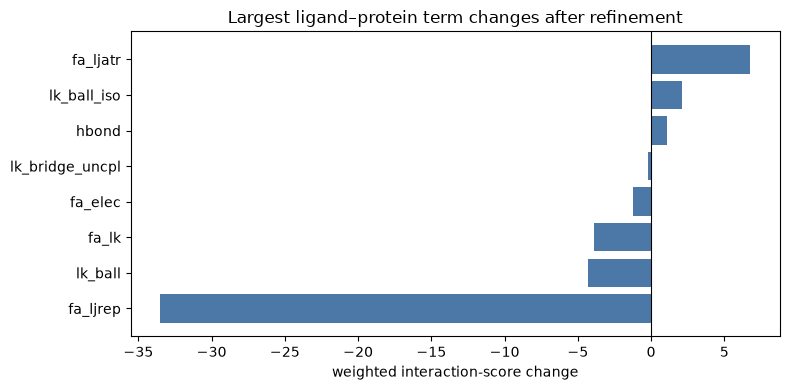
3Dmol.js failed to load for some reason. Please check your browser console for error messages.
3Dmol.js failed to load for some reason. Please check your browser console for error messages.
Next#
Exercises#
Reload
AMPC.generated.tmoland verify that AMPC atom names, partial charges, and cartbonded payload survive that.tmolround trip. Confirm that its source formal charge and partial-charge sum remain separate concepts. Do not compare it numerically with the chemically unrelated pinned ADA/LG1 artifact as a parity test.Inspect which
chi_samplesand proton-chi declarations the.tmolbundle carries forLG1, and confirm they survive a write/reload cycle unchanged.Change the 4.5 Å AtomArray pocket cutoff while leaving the two 5 Å protocol scopes unchanged, then quantify the effect on runtime and refined interaction score.
Separate ligand desolvation and protein desolvation contributions in the per-term interaction table.
Repeat pocket refinement with several packer seeds and report the interaction-score and structural spread.