

Tutorial 09 — Protein interface analysis#

Map interface contributions and test alanine substitutions in a batch of matched local-repacking tasks. Assumes scoring and packing.
The example uses neighboring chains A and B from KcsA (1BL8). It analyzes one subunit interface, not the full tetramer or membrane environment.
Setup#
In Colab, select T4 GPU, then Run all. For local execution, follow the installation guide. Setup installs TMol and downloads the fixtures on first use.
The setup fixes PyTorch’s random seed, loads protein atoms from chains A and B, and optimizes hydrogen coordinates before interpreting all-atom scores. TMol’s CPU packer uses a C random stream that torch.manual_seed() does not control; the CPU results below are illustrative single outcomes rather than replicates.
[1]:
try:
    import google.colab  # noqa: F401
except ImportError:
    IN_COLAB = False
else:
    IN_COLAB = True

if IN_COLAB:
    from urllib.request import urlopen

    exec(
        urlopen(
            "https://raw.githubusercontent.com/uw-ipd/tmol/"
            "master/docs/tutorial/colab_setup.py"
        ).read(),
        globals(),
    )
    setup_colab(["tmol/tests/data/cif/1BL8.cif"])
[2]:
from contextlib import redirect_stderr, redirect_stdout
from io import StringIO
from pathlib import Path
from time import perf_counter
import warnings

import matplotlib.pyplot as plt
import numpy as np
import pandas as pd
import torch
from IPython.display import display
from biotite.structure.io import load_structure

import tmol
from tmol.database import ParameterDatabase
from tmol.io import pose_stack_from_biotite
from tmol.ops import (
    calculate_block_pair_ddg,
    compute_block_adjacency,
    compute_block_centroids_and_furthest_dist,
    res_mask_to_coord_mask,
)
from tmol.pack import PackerPalette, PackerTask, pack_rotamers
from tmol.pack.rotamer import FixedAAChiSampler, IncludeCurrentSampler
from tmol.pack.rotamer.dunbrack import create_dunbrack_sampler_from_database
from tmol.pose import PoseStackBuilder
from tmol.score import ScoreType, beta2016_score_function

SEED = 20260829
np.random.seed(SEED)
torch.manual_seed(SEED)
if torch.cuda.is_available():
    torch.cuda.manual_seed_all(SEED)
warnings.filterwarnings(
    "ignore", message=r"Sparse invariant checks are implicitly disabled.*"
)

device = (
    torch.device("cuda", torch.cuda.current_device())
    if torch.cuda.is_available()
    else torch.device("cpu")
)
repo_root = Path.cwd()
if not (repo_root / "tmol/tests/data/cif/1BL8.cif").exists():
    repo_root = Path(tmol.__file__).resolve().parents[1]
cif_path = repo_root / "tmol/tests/data/cif/1BL8.cif"

atom_array = load_structure(str(cif_path), model=1, include_bonds=True)
protein_dimer = atom_array[
    ((atom_array.chain_id == "A") | (atom_array.chain_id == "B")) & ~atom_array.hetero
]
param_db = ParameterDatabase.get_default()
pose_diagnostics = StringIO()
try:
    with redirect_stdout(pose_diagnostics), redirect_stderr(pose_diagnostics):
        pose_stack = pose_stack_from_biotite(
            protein_dimer,
            device,
            param_db=param_db,
            no_optH=False,
        )
except Exception:
    print(pose_diagnostics.getvalue())
    raise

score_function = beta2016_score_function(device, param_db=param_db)


def show_table(frame):
    try:
        from itables import show
    except ImportError:
        display(frame)
        return None
    return show(frame)


def block_label(pose, block_index):
    chain = pose.pdb_info.chain_labels[0, block_index]
    residue = pose.pdb_info.residue_labels[0, block_index]
    insertion = pose.pdb_info.residue_insertion_codes[0, block_index]
    return f"{chain}:{residue}{insertion}"


chain_labels = pose_stack.pdb_info.chain_labels[0]
chain_a = torch.tensor([str(label) == "A" for label in chain_labels], device=device)
chain_b = torch.tensor([str(label) == "B" for label in chain_labels], device=device)
assert int(chain_a.sum()) == int(chain_b.sum()) == 97
print(
    f"device={device}; input={cif_path.name}; "
    f"blocks={pose_stack.max_n_blocks}; chains=A+B"
)
Environment variable CCD_MIRROR_PATH not set. Will not be able to use function requiring this variable. To set it you may:
  (1) add the line 'export VAR_NAME=path/to/variable' to your .bashrc or .zshrc file
  (2) set it in your current shell with 'export VAR_NAME=path/to/variable'
  (3) write it to a .env file in the root of the atomworks.io repository
Environment variable PDB_MIRROR_PATH not set. Will not be able to use function requiring this variable. To set it you may:
  (1) add the line 'export VAR_NAME=path/to/variable' to your .bashrc or .zshrc file
  (2) set it in your current shell with 'export VAR_NAME=path/to/variable'
  (3) write it to a .env file in the root of the atomworks.io repository
device=cpu; input=1BL8.cif; blocks=194; chains=A+B
Inspect the extracted neighboring-subunit interface#
The author chain labels survive pose construction and define the two partners. The viewer highlights chain A in blue within the extracted A–B dimer. This is a specific neighboring interface from the crystallographic tetramer; chains C and D, membrane context, ions, solvent, and separated partners are outside this case study.
[3]:
chain_a_atoms = res_mask_to_coord_mask(pose_stack, chain_a.unsqueeze(0))
try:
    interface_viewer = tmol.view(
        pose_stack,
        highlighted=chain_a_atoms[pose_stack.real_atoms],
        highlight_color="#2563eb",
    )
    print("Blue: chain A; unhighlighted partner: chain B.")
    interface_viewer.show()
except ImportError as exc:
    print("Interactive interface viewer unavailable:", exc)
Blue: chain A; unhighlighted partner: chain B.
3Dmol.js failed to load for some reason. Please check your browser console for error messages.
Map native interface contributions#
The block-pair scorer stores each unordered interaction in one directed matrix entry. For every A–B pair, the analysis therefore adds A→B and B→A before ranking residues. The hotspot ranking uses five explicit nonbonded terms: fa_ljatr, fa_ljrep, fa_lk, fa_elec, and hbond. The complete all-term cross-chain reduction is independently checked with calculate_block_pair_ddg().
The heat map is an energetic accounting view of this one fixed complex, not a contact probability or experimental residue contribution. Negative values are more favorable under the chosen weighted-term subset.
[4]:
block_scorer = score_function.render_block_pair_scoring_module(pose_stack)
weighted_by_term = block_scorer(pose_stack.coords, sum_terms=False, apply_weights=True)
score_types = score_function.all_score_types()

forward = weighted_by_term[:, 0][:, chain_a][:, :, chain_b]
reverse = weighted_by_term[:, 0][:, chain_b][:, :, chain_a].transpose(1, 2)
pair_by_term = forward + reverse
all_term_interface = pair_by_term.sum(dim=(1, 2))

chain_a_batch = chain_a.unsqueeze(0)
chain_b_batch = chain_b.unsqueeze(0)
helper_interface = calculate_block_pair_ddg(
    pose_stack,
    chain_a_batch,
    chain_b_batch,
    sfxn=score_function,
    sum_terms=False,
    minimize=False,
    pack=False,
)[:, 0]
torch.testing.assert_close(all_term_interface, helper_interface)

nonbonded_types = [
    ScoreType.fa_ljatr,
    ScoreType.fa_ljrep,
    ScoreType.fa_lk,
    ScoreType.fa_elec,
    ScoreType.hbond,
]
nonbonded_indices = [score_types.index(term) for term in nonbonded_types]
nonbonded_pairs = pair_by_term[nonbonded_indices].sum(dim=0)

chain_a_blocks = torch.nonzero(chain_a, as_tuple=False).flatten()
chain_b_blocks = torch.nonzero(chain_b, as_tuple=False).flatten()
chain_a_contributions = nonbonded_pairs.sum(dim=1)
chain_b_contributions = nonbonded_pairs.sum(dim=0)


def contribution_rows(blocks, contributions):
    rows = []
    for local_index, block_index_tensor in enumerate(blocks):
        block_index = int(block_index_tensor)
        rows.append(
            {
                "block_index": block_index,
                "author_label": block_label(pose_stack, block_index),
                "identity": pose_stack.block_type(0, block_index).name3,
                "five_term_interface_score": float(
                    contributions[local_index].detach().cpu()
                ),
            }
        )
    return rows


contribution_frame = pd.DataFrame(
    contribution_rows(chain_a_blocks, chain_a_contributions)
    + contribution_rows(chain_b_blocks, chain_b_contributions)
).sort_values("five_term_interface_score")
show_table(contribution_frame.head(16))

fig, ax = plt.subplots(figsize=(8.5, 6.5))
image = ax.imshow(
    nonbonded_pairs.detach().cpu(),
    cmap="coolwarm",
    aspect="auto",
    vmin=-max(1.0, float(nonbonded_pairs.abs().quantile(0.99).detach().cpu())),
    vmax=max(1.0, float(nonbonded_pairs.abs().quantile(0.99).detach().cpu())),
)
ax.set(
    xlabel="chain B block index within partner",
    ylabel="chain A block index within partner",
    title="KcsA A–B nonbonded block-pair accounting",
)
fig.colorbar(image, ax=ax, label="weighted score units")
plt.tight_layout()
plt.show()
| Loading ITables v2.9.1 from the internet... (need help?) |
| ⓘ | block_index | author_label | identity | five_term_interface_score |
|---|---|---|---|---|
| 55 | 55 | A:78 | TYR | -6.986691 |
| 182 | 182 | B:108 | ALA | -4.855317 |
| 80 | 80 | A:103 | PHE | -4.636461 |
| 98 | 98 | B:24 | LEU | -4.392588 |
| 156 | 156 | B:82 | TYR | -3.430945 |
| 88 | 88 | A:111 | ALA | -3.005775 |
| 92 | 92 | A:115 | VAL | -2.759958 |
| 90 | 90 | A:113 | TRP | -2.212945 |
| 146 | 146 | B:72 | THR | -1.648885 |
| 44 | 44 | A:67 | TRP | -1.638690 |
| (6 more rows not shown) | ||||
/home/runner/work/tmol/tmol/.venv/lib/python3.12/site-packages/matplotlib/cbook.py:713: DeprecationWarning: __array__ implementation doesn't accept a copy keyword, so passing copy=False failed. __array__ must implement 'dtype' and 'copy' keyword arguments. To learn more, see the migration guide https://numpy.org/devdocs/numpy_2_0_migration_guide.html#adapting-to-changes-in-the-copy-keyword
  x = np.array(x, subok=True, copy=copy)
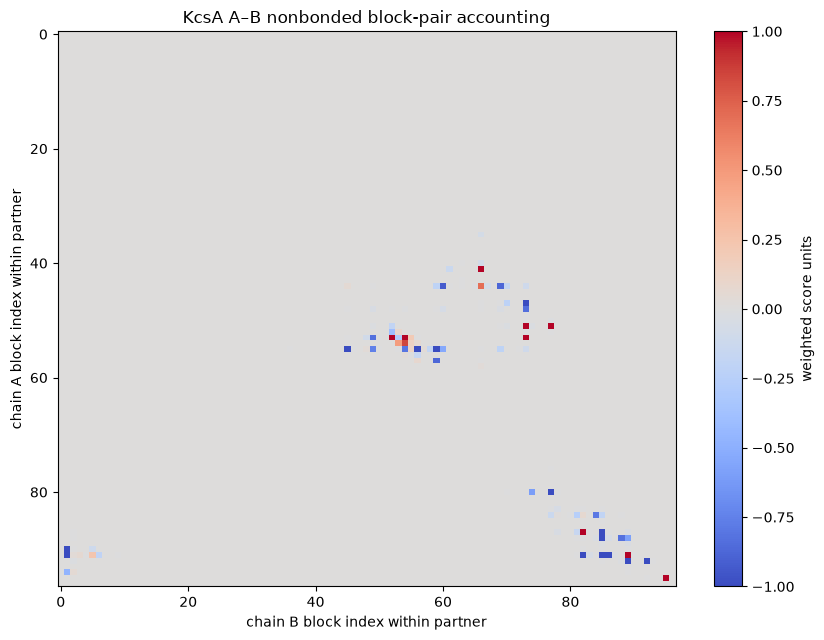
Sum both matrix orientations before ranking. Author labels preserve chain identity without assuming block ranges.
Choose three sites#
Select the three most favorable internal chain-A contributors excluding alanine and glycine. The next experiment tests these sites by repacking; native fixed-structure ranks need not predict the result.
[5]:
chain_a_block_list = chain_a_blocks.detach().cpu().tolist()
eligible = contribution_frame[
    (contribution_frame["author_label"].str.startswith("A:"))
    & ~contribution_frame["identity"].isin({"ALA", "GLY"})
    & contribution_frame["block_index"].isin(chain_a_block_list[1:-1])
]
hotspot_frame = eligible.head(3).copy().reset_index(drop=True)
hotspot_blocks = hotspot_frame["block_index"].astype(int).tolist()
assert len(hotspot_blocks) == 3
show_table(hotspot_frame)

hotspot_mask = torch.zeros_like(chain_a)
hotspot_mask[hotspot_blocks] = True
hotspot_atoms = res_mask_to_coord_mask(pose_stack, hotspot_mask.unsqueeze(0))
try:
    hotspot_viewer = tmol.view(
        pose_stack,
        highlighted=hotspot_atoms[pose_stack.real_atoms],
        highlight_color="#f97316",
    )
    print("Orange hotspots: " + ", ".join(hotspot_frame["author_label"].tolist()))
    hotspot_viewer.show()
except ImportError as exc:
    print("Interactive hotspot viewer unavailable:", exc)
Orange hotspots: A:78, A:103, A:115
3Dmol.js failed to load for some reason. Please check your browser console for error messages.
Test alanine substitutions in one packing batch#
Each site contributes two batch members: an independently repacked WT control and an alanine variant. Both use the same geometry-defined local packing shell. All blocks outside that shell remain fixed, every non-target block retains its identity, and the mutation target is restricted to alanine in only its mutant member.
compute_block_adjacency() uses enclosing residue spheres plus a 5 Å gap, so the shell is deliberately conservative rather than an exact atom-contact set. The batch exposes independent site/state work to one packer call. One outcome per state is enough to demonstrate the API, but not to estimate sampling uncertainty or establish convergence.
[6]:
requests = [
    (block_index, state)
    for block_index in hotspot_blocks
    for state in ("repacked WT", "ALA")
]
scan_batch = PoseStackBuilder.from_poses([pose_stack] * len(requests), device)
scan_task = PackerTask(scan_batch, PackerPalette())

mutation_mask = torch.zeros_like(scan_batch.block_type_ind, dtype=torch.bool)
for pose_index, (block_index, state) in enumerate(requests):
    if state == "ALA":
        mutation_mask[pose_index, block_index] = True

# Restrictions only remove choices. Preserve the original identity everywhere
# except mutant targets, then restrict those targets to alanine.
scan_task.restrict_to_repacking(~mutation_mask)
scan_task.restrict_absent_name3s({"ALA"}, mutation_mask)

centroids, radii = compute_block_centroids_and_furthest_dist(pose_stack)
adjacency = compute_block_adjacency(centroids, radii)
packing_shells = torch.zeros_like(scan_batch.block_type_ind, dtype=torch.bool)
for pose_index, (block_index, _) in enumerate(requests):
    packing_shells[pose_index] = adjacency[0, block_index]
    packing_shells[pose_index, block_index] = True
scan_task.disable_packing_by_block_mask(~packing_shells)

scan_task.add_conformer_sampler(create_dunbrack_sampler_from_database(param_db, device))
scan_task.add_conformer_sampler(FixedAAChiSampler())
scan_task.add_conformer_sampler(IncludeCurrentSampler())

torch.manual_seed(SEED)  # Controls CUDA annealing, not the CPU C RNG stream.
if device.type == "cuda":
    torch.cuda.synchronize()
scan_start = perf_counter()
packed_scan = pack_rotamers(scan_batch, score_function, scan_task)
if device.type == "cuda":
    torch.cuda.synchronize()
scan_seconds = perf_counter() - scan_start

for pose_index, (target_block, state) in enumerate(requests):
    expected = "ALA" if state == "ALA" else pose_stack.block_type(0, target_block).name3
    assert packed_scan.block_type(pose_index, target_block).name3 == expected
    for block_index in range(pose_stack.max_n_blocks):
        if block_index != target_block:
            assert (
                packed_scan.block_type(pose_index, block_index).name3
                == pose_stack.block_type(0, block_index).name3
            )

print(
    f"packed {len(requests)} site/state members in {scan_seconds:.3f} s; "
    f"shell sizes={packing_shells.sum(dim=1).detach().cpu().tolist()}"
)
packed 6 site/state members in 1.843 s; shell sizes=[41, 41, 40, 40, 24, 24]
Compare matched site/state calculations#
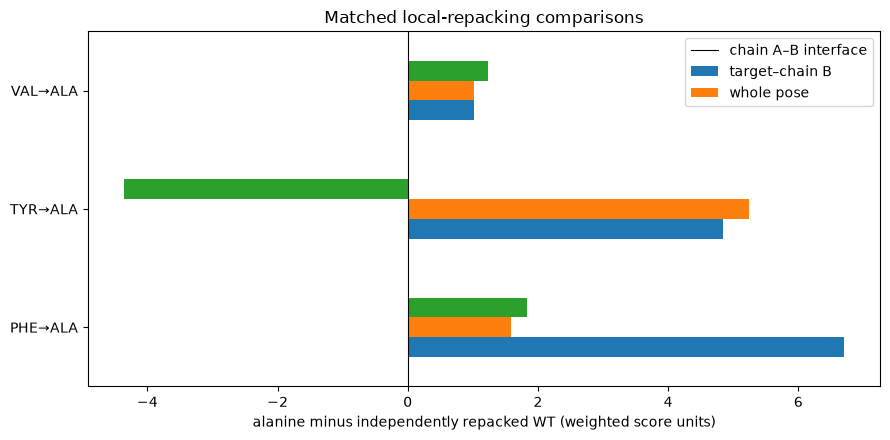
The interface score sums all weighted terms crossing chain A and chain B. The target-to-partner score uses one integer target block per batch member and chain B as its partner mask; this indexed reduction avoids constructing a dense target mask. Whole-pose totals provide a third diagnostic. Every mutant value is compared only with the independently repacked WT member for the same site and shell.
[7]:
chain_a_scan = chain_a.unsqueeze(0).expand(len(requests), -1).clone()
chain_b_scan = chain_b.unsqueeze(0).expand(len(requests), -1).clone()
interface_scores = calculate_block_pair_ddg(
    packed_scan,
    chain_a_scan,
    chain_b_scan,
    sfxn=score_function,
    minimize=False,
    pack=False,
)

target_indices = torch.tensor(
    [block_index for block_index, _ in requests],
    dtype=torch.int64,
    device=device,
)
target_partner_by_term = calculate_block_pair_ddg(
    packed_scan,
    target_indices,
    chain_b_scan,
    sfxn=score_function,
    sum_terms=False,
    minimize=False,
    pack=False,
)
target_partner_scores = target_partner_by_term.sum(dim=0)

whole_scorer = score_function.render_whole_pose_scoring_module(packed_scan)
whole_scores = whole_scorer(packed_scan.coords)

comparison_rows = []
term_change_rows = []
variant_poses = {}
variant_notes = {}
for site_index, target_block in enumerate(hotspot_blocks):
    wt_index = 2 * site_index
    mutant_index = wt_index + 1
    author_label = block_label(pose_stack, target_block)
    native_identity = pose_stack.block_type(0, target_block).name3
    comparison_rows.append(
        {
            "site": author_label,
            "mutation": f"{native_identity}→ALA",
            "packing_shell_blocks": int(packing_shells[wt_index].sum()),
            "interface_score_change": float(
                (interface_scores[mutant_index] - interface_scores[wt_index])
                .detach()
                .cpu()
            ),
            "target_partner_score_change": float(
                (target_partner_scores[mutant_index] - target_partner_scores[wt_index])
                .detach()
                .cpu()
            ),
            "whole_pose_score_change": float(
                (whole_scores[mutant_index] - whole_scores[wt_index]).detach().cpu()
            ),
        }
    )
    for term_index, score_type in enumerate(score_types):
        term_change_rows.append(
            {
                "site": author_label,
                "term": score_type.name,
                "target_partner_score_change": float(
                    (
                        target_partner_by_term[term_index, mutant_index]
                        - target_partner_by_term[term_index, wt_index]
                    )
                    .detach()
                    .cpu()
                ),
            }
        )
    for member_index, state in ((wt_index, "repacked WT"), (mutant_index, "ALA")):
        key = f"{author_label} · {state}"
        variant_poses[key] = packed_scan.split(member_index)
        variant_notes[key] = (
            f"{native_identity}→{packed_scan.block_type(member_index, target_block).name3}; "
            f"same {int(packing_shells[member_index].sum())}-block packing shell"
        )

comparison_frame = pd.DataFrame(comparison_rows).sort_values(
    "interface_score_change", ascending=False
)
show_table(comparison_frame)

plot_frame = comparison_frame.set_index("mutation")[
    [
        "interface_score_change",
        "target_partner_score_change",
        "whole_pose_score_change",
    ]
]
ax = plot_frame.plot.barh(figsize=(9, 4.5))
ax.axvline(0.0, color="black", linewidth=0.8)
ax.set(
    xlabel="alanine minus independently repacked WT (weighted score units)",
    ylabel="",
    title="Matched local-repacking comparisons",
)
ax.legend(
    ["chain A–B interface", "target–chain B", "whole pose"],
    loc="best",
)
plt.tight_layout()
plt.show()
[8]:
term_change_frame = pd.DataFrame(term_change_rows)
term_change_frame["absolute_change"] = term_change_frame[
    "target_partner_score_change"
].abs()
dominant_term_changes = (
    term_change_frame.sort_values("absolute_change", ascending=False)
    .groupby("site", as_index=False, group_keys=False)
    .head(5)
    .sort_values(["site", "absolute_change"], ascending=[True, False])
)
show_table(dominant_term_changes.drop(columns="absolute_change"))

try:
    display(
        tmol.switchable_view(
            variant_poses,
            notes=variant_notes,
            width=760,
            height=440,
        )
    )
except ImportError as exc:
    print("Interactive mutation comparison unavailable:", exc)
| Loading ITables v2.9.1 from the internet... (need help?) |
| ⓘ | site | term | target_partner_score_change |
|---|---|---|---|
| 25 | A:103 | fa_ljatr | 1.252462 |
| 27 | A:103 | fa_lk | 0.494723 |
| 26 | A:103 | fa_ljrep | -0.112866 |
| 28 | A:103 | fa_elec | 0.077627 |
| 29 | A:103 | hbond | 0.000000 |
| 50 | A:115 | fa_ljatr | 1.357802 |
| 51 | A:115 | fa_ljrep | -0.933425 |
| 52 | A:115 | fa_lk | 0.512924 |
| 67 | A:115 | lk_ball | -0.246301 |
| 53 | A:115 | fa_elec | 0.131921 |
| (5 more rows not shown) | |||
3Dmol.js failed to load for some reason. Please check your browser console for error messages.
3Dmol.js failed to load for some reason. Please check your browser console for error messages.
3Dmol.js failed to load for some reason. Please check your browser console for error messages.
3Dmol.js failed to load for some reason. Please check your browser console for error messages.
3Dmol.js failed to load for some reason. Please check your browser console for error messages.
3Dmol.js failed to load for some reason. Please check your browser console for error messages.
Local repacking can redistribute interactions beyond the target, so native contributions and mutation-score changes need not track each other. Inspect large repulsive terms, extreme movements, or non-finite values. Compare WT and mutant structures and repeat sampling before interpreting rank stability.
Exercises#
Scan five or ten chain-A sites and compare one large batch with chunked batches.
Add several packing outcomes per WT/mutant state and plot their distributions.
Replace the conservative enclosing-sphere shell with an explicitly documented atom-distance shell.
Minimize identical local coordinate masks after packing and compare pre/post-minimization rankings.
Repeat the analysis for A–D, another neighboring interface in the tetramer, and test symmetry consistency.