

Tutorial 13 — Extending the packer#

Subclass PackerPalette, audit rotamer candidates, export their coordinates, and verify a packed structure. Complete packing first.
Rotamer enumeration is deterministic for a fixed task. Annealing searches candidate assignments stochastically; candidate counts do not predict the final sequence.
Setup#
In Colab, select T4 GPU, then Run all. For local execution, follow the installation guide. Setup installs TMol and downloads the fixtures on first use.
The notebook loads the first ten residues of the checked-in 1UBQ structure and optimizes polar hydrogens before interpreting all-atom scores. Only one internal position is designable, keeping CPU documentation execution practical.
[1]:
try:
    import google.colab  # noqa: F401
except ImportError:
    IN_COLAB = False
else:
    IN_COLAB = True

if IN_COLAB:
    from urllib.request import urlopen

    exec(
        urlopen(
            "https://raw.githubusercontent.com/uw-ipd/tmol/"
            "master/docs/tutorial/colab_setup.py"
        ).read(),
        globals(),
    )
    setup_colab(["tmol/tests/data/cif/1UBQ.cif"])
[2]:
from contextlib import redirect_stderr, redirect_stdout
from io import StringIO
from pathlib import Path
import tempfile
import warnings

import matplotlib.pyplot as plt
import numpy as np
import pandas as pd
import torch
from IPython.display import display
from biotite.structure.io import load_structure

import tmol
from tmol.database import ParameterDatabase
from tmol.io import pose_stack_from_biotite
from tmol.numeric import coord_dihedrals
from tmol.ops import res_mask_to_coord_mask
from tmol.pack import PackerPalette, PackerTask, SetPackerTask, pack_rotamers
from tmol.pack.rotamer import FixedAAChiSampler, IncludeCurrentSampler, build_rotamers
from tmol.pack.rotamer.dunbrack import create_dunbrack_sampler_from_database
from tmol.score import beta2016_score_function

SEED = 20260910
np.random.seed(SEED)
torch.manual_seed(SEED)
if torch.cuda.is_available():
    torch.cuda.manual_seed_all(SEED)
warnings.filterwarnings(
    "ignore", message=r"Sparse invariant checks are implicitly disabled.*"
)

device = (
    torch.device("cuda", torch.cuda.current_device())
    if torch.cuda.is_available()
    else torch.device("cpu")
)
repo_root = Path.cwd()
if not (repo_root / "tmol/tests/data/cif/1UBQ.cif").exists():
    repo_root = Path(tmol.__file__).resolve().parents[1]
cif_path = repo_root / "tmol/tests/data/cif/1UBQ.cif"

parameter_db = ParameterDatabase.get_default()
atom_array = load_structure(str(cif_path), model=1, include_bonds=True)
protein_slice = atom_array[(atom_array.chain_id == "A") & (atom_array.res_id <= 10)]
diagnostics = StringIO()
try:
    with redirect_stdout(diagnostics), redirect_stderr(diagnostics):
        pose_stack = pose_stack_from_biotite(
            protein_slice,
            device,
            param_db=parameter_db,
            no_optH=False,
        )
except Exception:
    print(diagnostics.getvalue())
    raise
score_function = beta2016_score_function(device, param_db=parameter_db)


def show_table(frame):
    try:
        from itables import show
    except ImportError:
        return display(frame)
    return show(frame)


def total_score(pose):
    scorer = score_function.render_whole_pose_scoring_module(pose)
    return float(scorer(pose.coords).detach().cpu()[0])


print(
    f"TMol {tmol.__version__}; PyTorch {torch.__version__}; "
    f"device={device}; blocks={pose_stack.max_n_blocks}"
)
Environment variable CCD_MIRROR_PATH not set. Will not be able to use function requiring this variable. To set it you may:
  (1) add the line 'export VAR_NAME=path/to/variable' to your .bashrc or .zshrc file
  (2) set it in your current shell with 'export VAR_NAME=path/to/variable'
  (3) write it to a .env file in the root of the atomworks.io repository
Environment variable PDB_MIRROR_PATH not set. Will not be able to use function requiring this variable. To set it you may:
  (1) add the line 'export VAR_NAME=path/to/variable' to your .bashrc or .zshrc file
  (2) set it in your current shell with 'export VAR_NAME=path/to/variable'
  (3) write it to a .env file in the root of the atomworks.io repository
TMol 0.1.62; PyTorch 2.14.1+cpu; device=cpu; blocks=10
Subclass PackerPalette#
Start from the default L-amino-acid compatibility rules, retain a hydrophobic alphabet, and always keep the original type. A palette or task may remove choices but must not re-enable rejected types.
Only block 5 (LYS in the 1UBQ slice) is active. Every position retains at least one valid choice.
[3]:
class HydrophobicPalette(PackerPalette):
    """Allow a small hydrophobic alphabet plus each original block type."""

    def __init__(self, allowed_name3s=("ALA", "VAL", "LEU", "ILE", "PHE")):
        super().__init__()
        self.allowed_name3s = frozenset(allowed_name3s)

    def block_types_from_original(self, pbt, orig):
        n_allowed, allowed, is_original = super().block_types_from_original(
            pbt, orig
        )
        in_alphabet = torch.tensor(
            [
                block_type.name3 in self.allowed_name3s
                for block_type in pbt.active_block_types
            ],
            dtype=torch.bool,
            device=pbt.device,
        )
        real_choice = allowed >= 0
        keep = torch.zeros_like(allowed, dtype=torch.bool)
        keep[real_choice] = in_alphabet[allowed[real_choice]]
        keep = (keep | is_original) & real_choice

        order = torch.argsort((~keep).to(torch.int64), dim=2, stable=True)
        allowed = torch.gather(allowed, 2, order)
        is_original = torch.gather(is_original, 2, order)
        keep = torch.gather(keep, 2, order)
        allowed = torch.where(keep, allowed, torch.full_like(allowed, -1))
        is_original = is_original & keep
        n_allowed = keep.sum(dim=2)
        return n_allowed, allowed, is_original


target_block = 5
palette = HydrophobicPalette()
design_task = PackerTask(pose_stack, palette)
design_region = torch.zeros(
    (pose_stack.n_poses, pose_stack.max_n_blocks),
    dtype=torch.bool,
    device=device,
)
design_region[:, target_block] = True
design_task.disable_packing_by_block_mask(~design_region)

design_task.add_conformer_sampler(
    create_dunbrack_sampler_from_database(parameter_db, device)
)
design_task.add_conformer_sampler(FixedAAChiSampler())
design_task.add_conformer_sampler(IncludeCurrentSampler())

considered = design_task.per_block_considered_block_types[0, target_block]
allowed_mask = design_task.per_block_is_block_type_allowed[0, target_block]
identity_rows = []
for slot, (type_index, is_allowed) in enumerate(
    zip(considered.detach().cpu().tolist(), allowed_mask.detach().cpu().tolist())
):
    if type_index < 0:
        continue
    block_type = pose_stack.packed_block_types.active_block_types[type_index]
    identity_rows.append(
        {
            "choice_slot": slot,
            "block_type": block_type.name,
            "name3": block_type.name3,
            "allowed_after_palette": bool(is_allowed),
            "is_original": type_index == int(pose_stack.block_type_ind64[0, target_block]),
        }
    )
identity_frame = pd.DataFrame(identity_rows)
show_table(identity_frame)
assert identity_frame.loc[identity_frame.allowed_after_palette, "name3"].isin(
    palette.allowed_name3s | {pose_stack.block_type(0, target_block).name3}
).all()
[4]:
target_mask = torch.zeros_like(design_region)
target_mask[:, target_block] = True
target_atom_mask = res_mask_to_coord_mask(pose_stack, target_mask)
try:
    target_viewer = tmol.view(
        pose_stack,
        highlighted=target_atom_mask[pose_stack.real_atoms],
        highlight_color="#f58518",
        width=720,
        height=390,
    )
    print(
        f"Orange target: block {target_block}, "
        f"{pose_stack.block_type(0, target_block).name3}"
    )
    target_viewer.show()
except ImportError as exc:
    print("Interactive target viewer unavailable:", exc)
Orange target: block 5, LYS
3Dmol.js failed to load for some reason. Please check your browser console for error messages.
The table distinguishes considered choices from choices still allowed after applying the palette. Only the whitelist and the original LYS remain. Terminal or chemically incompatible variants are absent because the default palette rejected them before the subclass filtered the set.
Enumerate and audit rotamers before annealing#
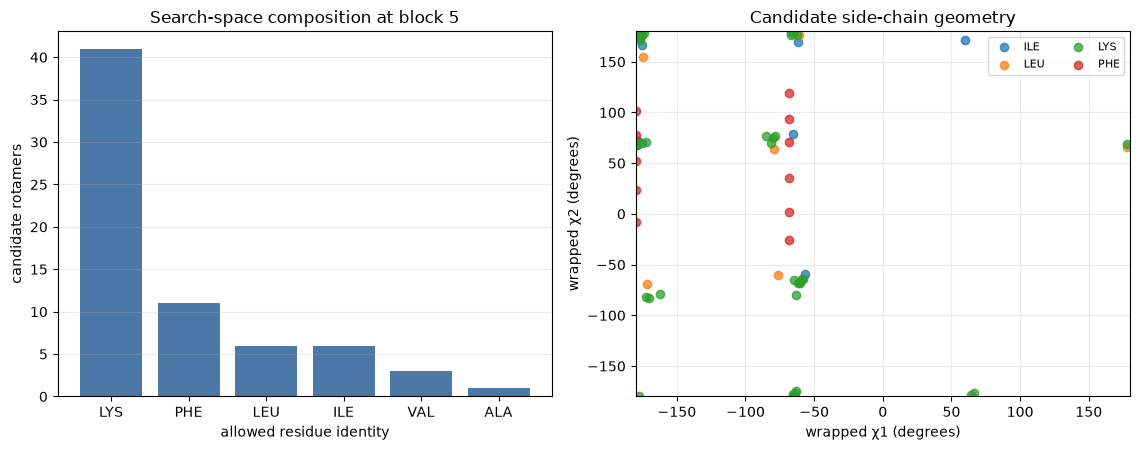
SetPackerTask freezes the task masks. build_rotamers() then combines every configured sampler into a coordinate ensemble. This is the right stage for auditing whether a custom alphabet and sampling policy produced the intended search space.
The identity-count plot answers how many candidates each residue type contributes. The χ plot shows their geometry. It does not show probabilities, energies, an annealing trajectory, or statistically independent samples.
[5]:
rotamer_pose, rotamer_set = build_rotamers(
    pose_stack,
    SetPackerTask.from_packer_task(design_task),
    pose_stack.packed_block_types.chem_db,
)
target_rotamer_count = int(rotamer_set.n_rots_for_block[0, target_block])
target_rotamer_offset = int(rotamer_set.rot_offset_for_block[0, target_block])

rotamer_rows = []
for local_rotamer in range(target_rotamer_count):
    rotamer_index = target_rotamer_offset + local_rotamer
    block_type_index = int(rotamer_set.block_type_ind_for_rot[rotamer_index])
    block_type = rotamer_pose.packed_block_types.active_block_types[
        block_type_index
    ]
    coordinate_offset = int(rotamer_set.coord_offset_for_rot[rotamer_index])
    row = {
        "local_rotamer": local_rotamer,
        "rotamer_index": rotamer_index,
        "block_type": block_type.name,
        "name3": block_type.name3,
    }
    for torsion_index in block_type.sc_torsions:
        atom_indices = block_type.ordered_torsions[torsion_index, :, 0]
        if np.any(atom_indices < 0):
            continue
        coordinates = rotamer_set.coords[
            coordinate_offset
            + torch.as_tensor(atom_indices, dtype=torch.long, device=device)
        ].double()
        radians = coord_dihedrals(
            coordinates[0:1],
            coordinates[1:2],
            coordinates[2:3],
            coordinates[3:4],
        )[0]
        name = block_type.torsions[torsion_index].name
        row[f"{name}_degrees"] = float(torch.rad2deg(radians).detach().cpu())
    rotamer_rows.append(row)

rotamer_frame = pd.DataFrame(rotamer_rows)
identity_counts = (
    rotamer_frame.groupby("name3", as_index=False)
    .size()
    .rename(columns={"size": "candidate_rotamers"})
    .sort_values("candidate_rotamers", ascending=False)
)
show_table(identity_counts)

fig, axes = plt.subplots(1, 2, figsize=(11.5, 4.6))
axes[0].bar(identity_counts.name3, identity_counts.candidate_rotamers, color="#4c78a8")
axes[0].set(
    xlabel="allowed residue identity",
    ylabel="candidate rotamers",
    title=f"Search-space composition at block {target_block}",
)
axes[0].grid(axis="y", alpha=0.25)

if {"chi1_degrees", "chi2_degrees"}.issubset(rotamer_frame.columns):
    for name3, values in rotamer_frame.dropna(
        subset=["chi1_degrees", "chi2_degrees"]
    ).groupby("name3"):
        axes[1].scatter(
            (values.chi1_degrees + 180.0) % 360.0 - 180.0,
            (values.chi2_degrees + 180.0) % 360.0 - 180.0,
            label=name3,
            alpha=0.75,
        )
    axes[1].legend(fontsize=8, ncol=2)
axes[1].set(
    xlim=(-180, 180),
    ylim=(-180, 180),
    xlabel="wrapped χ1 (degrees)",
    ylabel="wrapped χ2 (degrees)",
    title="Candidate side-chain geometry",
)
axes[1].grid(alpha=0.25)
plt.tight_layout()
plt.show()

assert target_rotamer_count == int(identity_counts.candidate_rotamers.sum())
Inspect and export candidates#
The helper converts each target rotamer’s packed coordinates into a single-residue PDB model and joins them into a multi-model file. Neighbors and energies are excluded.
The viewer shows up to twelve candidates. rotamer_ensemble_pdb and the temporary file contain the full ensemble.
[6]:
def rotamer_pdb_body(rotamer_index):
    block_type_index = int(rotamer_set.block_type_ind_for_rot[rotamer_index])
    block_type = rotamer_pose.packed_block_types.active_block_types[
        block_type_index
    ]
    coordinate_offset = int(rotamer_set.coord_offset_for_rot[rotamer_index])
    lines = []
    for atom_index, atom in enumerate(block_type.atoms, start=1):
        x, y, z = rotamer_set.coords[
            coordinate_offset + atom_index - 1
        ].detach().cpu().tolist()
        element = "".join(character for character in atom.name if character.isalpha())[:1]
        lines.append(
            f"ATOM  {atom_index:5d} {atom.name:<4} {block_type.name3:>3} A"
            f"{target_block + 1:4d}    {x:8.3f}{y:8.3f}{z:8.3f}"
            f"  1.00  0.00          {element:>2}"
        )
    return block_type.name3, "\n".join(lines) + "\n"


models = []
candidate_views = {}
candidate_notes = {}
for local_rotamer in range(target_rotamer_count):
    rotamer_index = target_rotamer_offset + local_rotamer
    name3, body = rotamer_pdb_body(rotamer_index)
    models.append(f"MODEL     {local_rotamer + 1:4d}\n{body}ENDMDL\n")
    if local_rotamer < 12:
        label = f"{local_rotamer:02d}: {name3}"
        candidate_views[label] = body + "END\n"
        candidate_notes[label] = "One enumerated side-chain candidate; no packing score applied"

rotamer_ensemble_pdb = "".join(models)
export_dir = Path(tempfile.mkdtemp(prefix="tmol-rotamer-tutorial-"))
export_path = export_dir / "block5_rotamer_ensemble.pdb"
export_path.write_text(rotamer_ensemble_pdb)
print(
    f"wrote {target_rotamer_count} models to {export_path.name}; "
    f"bytes={export_path.stat().st_size}"
)
print("\n".join(rotamer_ensemble_pdb.splitlines()[:8]))

try:
    display(
        tmol.switchable_view(
            candidate_views,
            notes=candidate_notes,
            width=620,
            height=360,
        )
    )
except ImportError as exc:
    print("Interactive rotamer selector unavailable:", exc)
wrote 68 models to block5_rotamer_ensemble.pdb; bytes=112728
MODEL        1
ATOM      1 N    ALA A   6      27.751  35.867  13.740  1.00  0.00           N
ATOM      2 CA   ALA A   6      27.691  37.315  14.143  1.00  0.00           C
ATOM      3 C    ALA A   6      28.469  37.475  15.420  1.00  0.00           C
ATOM      4 O    ALA A   6      28.213  36.753  16.411  1.00  0.00           O
ATOM      5 CB   ALA A   6      26.260  37.797  14.331  1.00  0.00           C
ATOM      6 H    ALA A   6      27.087  35.218  14.137  1.00  0.00           H
ATOM      7 HA   ALA A   6      28.141  37.914  13.350  1.00  0.00           H
3Dmol.js failed to load for some reason. Please check your browser console for error messages.
3Dmol.js failed to load for some reason. Please check your browser console for error messages.
3Dmol.js failed to load for some reason. Please check your browser console for error messages.
3Dmol.js failed to load for some reason. Please check your browser console for error messages.
3Dmol.js failed to load for some reason. Please check your browser console for error messages.
3Dmol.js failed to load for some reason. Please check your browser console for error messages.
3Dmol.js failed to load for some reason. Please check your browser console for error messages.
3Dmol.js failed to load for some reason. Please check your browser console for error messages.
3Dmol.js failed to load for some reason. Please check your browser console for error messages.
3Dmol.js failed to load for some reason. Please check your browser console for error messages.
3Dmol.js failed to load for some reason. Please check your browser console for error messages.
3Dmol.js failed to load for some reason. Please check your browser console for error messages.
Switching candidates changes side-chain identity and/or χ geometry while preserving the local backbone frame used to construct the rotamers. The multi-model file is a geometry audit artifact. It is not a trajectory, an ordered energy ranking, or a collection of independently packed structures.
Run the assignment search and verify the result#
Only now does pack_rotamers() score interacting candidates and run the annealer. The result must belong to the audited palette, every non-target identity must remain unchanged, and backbone coordinates must remain fixed. CPU and CUDA use different stochastic search implementations, so the chosen identity and score need not match across devices.
[7]:
input_score = total_score(pose_stack)
torch.manual_seed(SEED)
packed_pose = pack_rotamers(
    pose_stack, score_function, design_task, verbose=False
)
packed_score = total_score(packed_pose)
original_identity = pose_stack.block_type(0, target_block).name3
packed_identity = packed_pose.block_type(0, target_block).name3

result_frame = pd.DataFrame(
    [
        {
            "stage": "input",
            "target_identity": original_identity,
            "weighted_score_units": input_score,
            "score_change": 0.0,
        },
        {
            "stage": "custom-palette packing",
            "target_identity": packed_identity,
            "weighted_score_units": packed_score,
            "score_change": packed_score - input_score,
        },
    ]
)
show_table(result_frame)

for block in range(pose_stack.max_n_blocks):
    if block != target_block:
        assert packed_pose.block_type(0, block).name3 == pose_stack.block_type(0, block).name3
assert packed_identity in palette.allowed_name3s | {original_identity}

# N, CA, C, and O coordinates are unaffected by side-chain packing.
max_backbone_change = 0.0
for block in range(pose_stack.max_n_blocks):
    before_type = pose_stack.block_type(0, block)
    after_type = packed_pose.block_type(0, block)
    before_offset = int(pose_stack.block_coord_offset64[0, block])
    after_offset = int(packed_pose.block_coord_offset64[0, block])
    for atom_name in ("N", "CA", "C", "O"):
        delta = (
            packed_pose.coords[0, after_offset + after_type.atom_to_idx[atom_name]]
            - pose_stack.coords[0, before_offset + before_type.atom_to_idx[atom_name]]
        )
        max_backbone_change = max(
            max_backbone_change,
            float(torch.linalg.vector_norm(delta).detach().cpu()),
        )
print(f"maximum backbone coordinate change: {max_backbone_change:.6f} Å")
assert max_backbone_change < 1e-4
maximum backbone coordinate change: 0.000000 Å
[8]:
try:
    display(
        tmol.switchable_view(
            {
                f"input ({original_identity})": pose_stack,
                f"packed ({packed_identity})": packed_pose,
            },
            notes={
                f"input ({original_identity})": f"weighted score {input_score:.3f}",
                f"packed ({packed_identity})": (
                    f"weighted score {packed_score:.3f}; "
                    f"change {packed_score - input_score:+.3f}"
                ),
            },
            width=720,
            height=400,
        )
    )
except ImportError as exc:
    print("Interactive packed comparison unavailable:", exc)
3Dmol.js failed to load for some reason. Please check your browser console for error messages.
3Dmol.js failed to load for some reason. Please check your browser console for error messages.
The packed target is either one hydrophobic alphabet member or the retained original LYS. The rest of the sequence and all backbone coordinates remain fixed. The table reports the score change for this packing outcome.
Validation#
Start from
super().block_types_from_original()so chemical compatibility is preserved.Only remove
Truechoices; never manufacture a block-type index that was not considered.Retain at least one valid choice at every real block.
Audit identity and rotamer counts before annealing.
Distinguish deterministic candidate enumeration from stochastic assignment search.
Verify unchanged identities and coordinates outside the intended region.
Exercises#
Add TYR and TRP to the palette and compare how identity and rotamer counts change.
Apply
or_expand_chi(0)only at the target and compare χ-space before and after expansion.Pack several identical poses in one batch and summarize the distribution of selected identities without treating CPU and CUDA outcomes as the same protocol.