

Tutorial 08 — DNA and RNA#

Load DNA, RNA, and protein–DNA structures; inspect score terms and chi sampling; swap a base pair; and repack an RNA aptamer around a ligand. Assumes Tutorials 01–06; see ligand preparation for the aptamer example.
Short runs do not establish sampling convergence.
Setup#
In Colab, select T4 GPU, then Run all. For local execution, follow the installation guide. Setup installs TMol and downloads the fixtures on first use.
The three structures are checked into the repository so the executed documentation never depends on a live structure download. CIF is the primary input because it preserves richer chemical and author metadata than PDB; the ligand-bearing aptamer additionally uses CIF chemical-component bonds during ligand preparation.
[1]:
try:
    import google.colab  # noqa: F401
except ImportError:
    IN_COLAB = False
else:
    IN_COLAB = True

if IN_COLAB:
    from urllib.request import urlopen

    exec(
        urlopen(
            "https://raw.githubusercontent.com/uw-ipd/tmol/"
            "master/docs/tutorial/colab_setup.py"
        ).read(),
        globals(),
    )
    setup_colab(
        [
            "tmol/tests/data/cif/1BNA.cif",
            "tmol/tests/data/cif/1HDD.cif",
            "tmol/tests/data/cif/1EHT.cif",
        ]
    )
[2]:
from contextlib import redirect_stderr, redirect_stdout
from io import StringIO
from pathlib import Path

import matplotlib.pyplot as plt
import numpy as np
import pandas as pd
import torch
from IPython.display import display
from biotite.structure.io import load_structure

import tmol
from tmol.database import ParameterDatabase
from tmol.io import pose_stack_from_biotite
from tmol.ops import (
    build_sidechain_coord_mask,
    compute_block_adjacency,
    compute_block_centroids_and_furthest_dist,
    res_mask_to_coord_mask,
)
from tmol.optimization import run_cart_min
from tmol.pack import PackerPalette, PackerTask, SetPackerTask, pack_rotamers
from tmol.pack.rotamer import (
    FixedAAChiSampler,
    IncludeCurrentSampler,
    NaChiRotamerSampler,
)
from tmol.pack.rotamer.dunbrack import create_dunbrack_sampler_from_database
from tmol.pose import PoseStackBuilder
from tmol.score import ScoreType, beta2016_score_function

SEED = 20260808
np.random.seed(SEED)
torch.manual_seed(SEED)
if torch.cuda.is_available():
    torch.cuda.manual_seed_all(SEED)

device = (
    torch.device("cuda", torch.cuda.current_device())
    if torch.cuda.is_available()
    else torch.device("cpu")
)
param_db = ParameterDatabase.get_default()
score_function = beta2016_score_function(device, param_db=param_db)
repo_root = Path.cwd()
if not (repo_root / "tmol/tests/data/cif/1BNA.cif").exists():
    repo_root = Path(tmol.__file__).resolve().parents[1]


def show_table(frame):
    try:
        from itables import show
    except ImportError:
        return display(frame)
    return show(frame)


def build_pose(atom_array, *, prepare_ligands=False, return_context=False):
    diagnostics = StringIO()
    try:
        with redirect_stdout(diagnostics), redirect_stderr(diagnostics):
            return pose_stack_from_biotite(
                atom_array,
                device,
                param_db=param_db,
                no_optH=True,
                prepare_ligands=prepare_ligands,
                return_context=return_context,
            )
    except Exception:
        print(diagnostics.getvalue())
        raise


def block_mask_for_chains(pose, chains):
    labels = np.asarray(pose.pdb_info.chain_labels)
    return torch.as_tensor(np.isin(labels, list(chains)), device=pose.device)


def block_mask_for_name3(pose, names):
    mask = torch.zeros_like(pose.block_type_ind, dtype=torch.bool)
    for pose_index in range(pose.n_poses):
        for block_index in range(pose.max_n_blocks):
            if int(pose.block_type_ind64[pose_index, block_index]) < 0:
                continue
            mask[pose_index, block_index] = pose.block_type(
                pose_index, block_index
            ).name3 in names
    return mask


NA_NAMES = {"DA", "DC", "DG", "DT", "A", "C", "G", "U"}
PROTON_CHI_HYDROGENS = {"HO2'", "HO3'", "HO5'"}
ELEMENT_BY_ATOM_TYPE = {
    atom_type.name: atom_type.element for atom_type in param_db.chemical.atom_types
}


def build_na_base_and_proton_chi_coord_mask(pose, block_mask):
    """Select NA bases and hydroxyl proton-chi atoms, fixing sugar/phosphate."""
    mask = torch.zeros_like(pose.real_atoms)
    for pose_index, block_index in torch.nonzero(block_mask, as_tuple=False).tolist():
        block_type = pose.block_type(pose_index, block_index)
        if block_type.name3 not in NA_NAMES:
            raise ValueError(f"Expected a nucleotide, got {block_type.name3}")
        offset = int(pose.block_coord_offset64[pose_index, block_index])
        for atom_index, atom in enumerate(block_type.atoms):
            name = atom.name
            is_sugar = "'" in name
            is_phosphate = (
                name == "P"
                or name.startswith("OP")
                or (name.startswith("O") and name.endswith("P"))
            )
            if (not is_sugar and not is_phosphate) or name in PROTON_CHI_HYDROGENS:
                mask[pose_index, offset + atom_index] = True
    return mask


def heavy_atom_coord_mask(pose, block_mask):
    mask = torch.zeros_like(pose.real_atoms)
    for pose_index, block_index in torch.nonzero(block_mask, as_tuple=False).tolist():
        block_type = pose.block_type(pose_index, block_index)
        offset = int(pose.block_coord_offset64[pose_index, block_index])
        for atom_index, atom in enumerate(block_type.atoms):
            if ELEMENT_BY_ATOM_TYPE.get(atom.atom_type) != "H":
                mask[pose_index, offset + atom_index] = True
    return mask


def atom_coord_for_block(pose, block_index, atom_name, pose_index=0):
    block_type = pose.block_type(pose_index, block_index)
    matching = [
        atom_index
        for atom_index, atom in enumerate(block_type.atoms)
        if atom.name == atom_name
    ]
    if len(matching) != 1:
        raise ValueError(
            f"Expected one {atom_name} in block {block_index} "
            f"({block_type.name3}); found {len(matching)}"
        )
    offset = int(pose.block_coord_offset64[pose_index, block_index])
    return pose.coords[pose_index, offset + matching[0]]


def named_atom_distance(pose, first_block, first_atom, second_block, second_atom):
    distance = torch.linalg.vector_norm(
        atom_coord_for_block(pose, first_block, first_atom)
        - atom_coord_for_block(pose, second_block, second_atom)
    )
    return float(distance.detach().cpu())


def interface_geometry_diagnostics(pose, first_blocks, second_blocks, cutoff=2.0):
    first = pose.coords[heavy_atom_coord_mask(pose, first_blocks)]
    second = pose.coords[heavy_atom_coord_mask(pose, second_blocks)]
    distances = torch.cdist(first, second)
    return {
        "minimum_intergroup_heavy_atom_distance_A": float(distances.min().detach().cpu()),
        f"intergroup_heavy_atom_pairs_below_{cutoff:g}A": int(
            (distances < cutoff).sum().detach().cpu()
        ),
    }


def covalent_bond_pairs(pose):
    """Return unique intra- and inter-residue covalent coordinate-index pairs."""
    pairs = set()
    for block_index in range(pose.max_n_blocks):
        if int(pose.block_type_ind64[0, block_index]) < 0:
            continue
        block_type = pose.block_type(0, block_index)
        offset = int(pose.block_coord_offset64[0, block_index])
        for first, second in block_type.bond_indices:
            first, second = int(first), int(second)
            if first < second:
                pairs.add((offset + first, offset + second))
        for connection_index, atom_index in enumerate(
            block_type.ordered_connection_atoms
        ):
            partner_block, partner_connection = pose.inter_residue_connections64[
                0, block_index, connection_index
            ].tolist()
            if partner_block < 0:
                continue
            partner_type = pose.block_type(0, partner_block)
            partner_offset = int(pose.block_coord_offset64[0, partner_block])
            partner_atom = int(
                partner_type.ordered_connection_atoms[partner_connection]
            )
            pair = tuple(
                sorted((offset + int(atom_index), partner_offset + partner_atom))
            )
            pairs.add(pair)
    return sorted(pairs)


def bond_length_change_diagnostics(before, after, scope_mask):
    """Measure covalent bond-length drift from a pre-refinement reference."""
    pairs = [
        pair
        for pair in covalent_bond_pairs(before)
        if bool(scope_mask[0, pair[0]] or scope_mask[0, pair[1]])
    ]
    first = torch.tensor([pair[0] for pair in pairs], device=before.device)
    second = torch.tensor([pair[1] for pair in pairs], device=before.device)
    before_lengths = torch.linalg.vector_norm(
        before.coords[0, first] - before.coords[0, second], dim=-1
    )
    after_lengths = torch.linalg.vector_norm(
        after.coords[0, first] - after.coords[0, second], dim=-1
    )
    changes = after_lengths - before_lengths
    return {
        "covalent_bonds_touching_movable_atoms": len(pairs),
        "bond_length_RMS_change_A": float(
            torch.sqrt(torch.mean(changes.square())).detach().cpu()
        ),
        "maximum_absolute_bond_length_change_A": float(
            changes.abs().max().detach().cpu()
        ),
    }


print(f"device={device}; TMol={tmol.__version__}")
Environment variable CCD_MIRROR_PATH not set. Will not be able to use function requiring this variable. To set it you may:
  (1) add the line 'export VAR_NAME=path/to/variable' to your .bashrc or .zshrc file
  (2) set it in your current shell with 'export VAR_NAME=path/to/variable'
  (3) write it to a .env file in the root of the atomworks.io repository
Environment variable PDB_MIRROR_PATH not set. Will not be able to use function requiring this variable. To set it you may:
  (1) add the line 'export VAR_NAME=path/to/variable' to your .bashrc or .zshrc file
  (2) set it in your current shell with 'export VAR_NAME=path/to/variable'
  (3) write it to a .env file in the root of the atomworks.io repository
device=cpu; TMol=0.1.62
Three nucleic-acid systems#
1BNA provides canonical B-form DNA. The 1HDD structure contains two engrailed homeodomains bound to a DNA duplex; one homeodomain uses an N-terminal arm in the minor groove and a recognition helix in the major groove. The 1EHT NMR model is a 33-nt RNA aptamer surrounding theophylline. The overview below compares polymer-only poses; the later aptamer section reloads the full 1EHT CIF and prepares TEP.
[3]:
cif_paths = {
    "B-form DNA — 1BNA": repo_root / "tmol/tests/data/cif/1BNA.cif",
    "engrailed homeodomain–DNA — 1HDD": repo_root / "tmol/tests/data/cif/1HDD.cif",
    "theophylline RNA aptamer — 1EHT": repo_root / "tmol/tests/data/cif/1EHT.cif",
}
atom_arrays = {
    label: load_structure(str(path), model=1, include_bonds=True)
    for label, path in cif_paths.items()
}
polymer_arrays = {
    label: atoms[~atoms.hetero]
    for label, atoms in atom_arrays.items()
}

poses = {
    "B-form DNA — 1BNA": build_pose(polymer_arrays["B-form DNA — 1BNA"]),
    "engrailed homeodomain–DNA — 1HDD": build_pose(
        polymer_arrays["engrailed homeodomain–DNA — 1HDD"]
    ),
    "RNA aptamer without ligand — 1EHT": build_pose(
        polymer_arrays["theophylline RNA aptamer — 1EHT"]
    ),
}
overview_rows = []
for label, pose in poses.items():
    name3s = [
        pose.block_type(0, block_index).name3
        for block_index in range(pose.max_n_blocks)
        if int(pose.block_type_ind64[0, block_index]) >= 0
    ]
    overview_rows.append(
        {
            "structure": label,
            "blocks": len(name3s),
            "DNA blocks": sum(name in {"DA", "DC", "DG", "DT"} for name in name3s),
            "RNA blocks": sum(name in {"A", "C", "G", "U"} for name in name3s),
            "finite coordinates": bool(torch.isfinite(pose.coords[pose.real_atoms]).all()),
        }
    )
show_table(pd.DataFrame(overview_rows))
display(tmol.switchable_view(poses))
3Dmol.js failed to load for some reason. Please check your browser console for error messages.
3Dmol.js failed to load for some reason. Please check your browser console for error messages.
3Dmol.js failed to load for some reason. Please check your browser console for error messages.
Score terms that act on DNA and RNA#
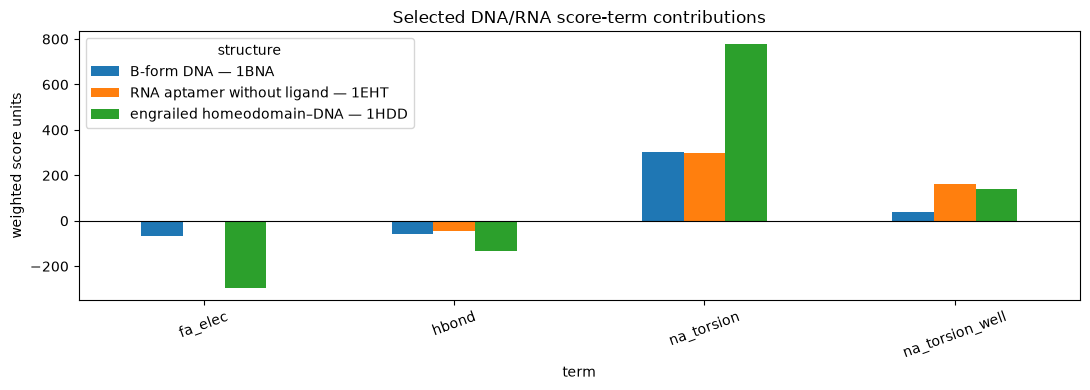
beta2016 includes the ordinary all-atom nonbonded terms—including anisotropic and isotropic lk_ball solvation—nucleic-acid cartbonded parameters, and the combined na_torsion/na_torsion_well model added for DNA and RNA. RNA 2′-OH geometry also contributes through cart_hxltorsions; canonical DNA lacks those hydroxyl-torsion rows. The table reports a curated set of weighted values from the same score function, including the small bridge-solvation terms.
For the NA-only DNA and RNA poses, amino-acid-only backbone/reference/rotamer terms (rama, omega, ref, and the Dunbrack terms) are expected to be zero; gen_torsions is likewise unparameterized for canonical NA. The code asserts those expected gaps and retains their zero rows. They can be nonzero in the mixed protein–DNA pose, so the expectation column is scoped explicitly to NA-only systems.
[4]:
term_rows = []
for structure_label, pose in poses.items():
    scorer = score_function.render_whole_pose_scoring_module(pose)
    weighted = scorer(pose.coords, sum_terms=False, apply_weights=True)[:, 0]
    for score_type, value in zip(score_function.all_score_types(), weighted):
        term_rows.append(
            {
                "structure": structure_label,
                "term": score_type.name,
                "weighted_value": float(value.detach().cpu()),
            }
        )
term_frame = pd.DataFrame(term_rows)
na_active_terms = [
    "fa_ljatr",
    "fa_ljrep",
    "fa_lk",
    "fa_elec",
    "hbond",
    "lk_ball_iso",
    "lk_ball",
    "lk_bridge",
    "lk_bridge_uncpl",
    "cart_lengths",
    "cart_angles",
    "cart_torsions",
    "cart_hxltorsions",
    "na_torsion",
    "na_torsion_well",
]
na_inactive_terms = [
    "gen_torsions",
    "cart_impropers",
    "rama",
    "omega",
    "ref",
    "dunbrack_rot",
    "dunbrack_rotdev",
    "dunbrack_semirot",
]
na_only_structures = {
    "B-form DNA — 1BNA",
    "RNA aptamer without ligand — 1EHT",
}
expected_zero = term_frame[
    term_frame["structure"].isin(na_only_structures)
    & term_frame["term"].isin(na_inactive_terms)
]
assert np.allclose(expected_zero["weighted_value"], 0.0)
term_frame["NA-only expectation"] = np.where(
    term_frame["term"].isin(na_inactive_terms),
    "zero (no canonical-NA parameterization)",
    "parameterized / applicability-dependent",
)
key_terms = na_active_terms + na_inactive_terms
show_table(term_frame[term_frame["term"].isin(key_terms)])

plot_frame = term_frame[
    term_frame["term"].isin(["hbond", "fa_elec", "na_torsion", "na_torsion_well"])
].pivot(index="term", columns="structure", values="weighted_value")
ax = plot_frame.plot.bar(figsize=(11, 4))
ax.axhline(0, color="black", linewidth=0.8)
ax.set(ylabel="weighted score units", title="Selected DNA/RNA score-term contributions")
ax.tick_params(axis="x", rotation=20)
plt.tight_layout()
plt.show()
| Loading ITables v2.9.1 from the internet... (need help?) |
| ⓘ | structure | term | weighted_value | NA-only expectation |
|---|---|---|---|---|
| 0 | B-form DNA — 1BNA | fa_ljatr | -314.338623 | parameterized / applicability-dependent |
| 1 | B-form DNA — 1BNA | fa_ljrep | 35.431664 | parameterized / applicability-dependent |
| 2 | B-form DNA — 1BNA | fa_lk | 114.828537 | parameterized / applicability-dependent |
| 3 | B-form DNA — 1BNA | fa_elec | -68.453720 | parameterized / applicability-dependent |
| 4 | B-form DNA — 1BNA | hbond | -57.070004 | parameterized / applicability-dependent |
| 5 | B-form DNA — 1BNA | cart_lengths | 12.928965 | parameterized / applicability-dependent |
| 6 | B-form DNA — 1BNA | cart_angles | 42.472569 | parameterized / applicability-dependent |
| 7 | B-form DNA — 1BNA | cart_torsions | 2.415583 | parameterized / applicability-dependent |
| 8 | B-form DNA — 1BNA | cart_impropers | 0.000000 | zero (no canonical-NA parameterization) |
| 9 | B-form DNA — 1BNA | cart_hxltorsions | 0.000000 | parameterized / applicability-dependent |
| (59 more rows not shown) | ||||
Glycosidic-chi sampling#
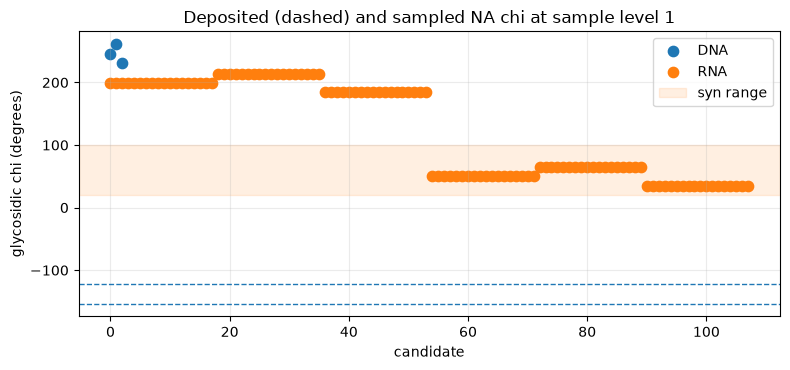
NaChiRotamerSampler uses the NA torsion model’s fitted wells: anti for DNA, and anti plus eligible syn wells for RNA. RNA counts can also include hydroxyl-proton chi combinations. Sugar pucker comes from the input and is not sampled.
The table measures deposited chi1 and reports pucker_weights(): dominant bin (0–9) and north-state weight. These are model classifications, not crystallographic pseudorotation angles. TMol has no stable high-level pseudorotation phase/amplitude API.
[5]:
from tmol.numeric import coord_dihedrals
from tmol.score.na_torsion import (
    NORTH_PUCKERS,
    SYN_RANGE,
    pucker_weights,
    sugar_ring_atoms,
)


def deposited_na_geometry(pose, block_index, sampler):
    block_type = pose.block_type(0, block_index)
    offset = int(pose.block_coord_offset64[0, block_index])
    chi_atoms = [int(uaid[0]) for uaid in block_type.torsion_to_uaids["chi1"]]
    chi_xyz = pose.coords[0, offset + torch.tensor(chi_atoms, device=device)].double()
    deposited_chi = float(
        torch.rad2deg(
            coord_dihedrals(
                chi_xyz[0:1], chi_xyz[1:2], chi_xyz[2:3], chi_xyz[3:4]
            )[0]
        )
        .detach()
        .cpu()
    )
    ring_atoms = sugar_ring_atoms(block_type, ELEMENT_BY_ATOM_TYPE)
    if ring_atoms is None:
        raise RuntimeError(f"No complete sugar ring for block {block_index}")
    ring_xyz = pose.coords[
        0, offset + torch.tensor(ring_atoms, device=device)
    ].unsqueeze(0)
    weights = pucker_weights(ring_xyz, sampler.params.pucker_temperature)[0]
    return {
        "deposited_chi_degrees": deposited_chi,
        "deposited_chi_syn_range": bool(
            SYN_RANGE[0] <= deposited_chi % 360.0 <= SYN_RANGE[1]
        ),
        "dominant_deposited_pucker_bin": int(torch.argmax(weights).item()),
        "deposited_north_pucker_weight": float(
            weights[list(NORTH_PUCKERS)].sum().detach().cpu()
        ),
    }


def sampled_na_chis(label, pose, block_index):
    sampler = NaChiRotamerSampler.from_database(
        param_db, device, chi_sample_level=1, sample_syn=True
    )
    task = PackerTask(pose, PackerPalette())
    task.restrict_to_repacking()
    enabled = torch.zeros_like(pose.block_type_ind, dtype=torch.bool)
    enabled[:, block_index] = True
    task.disable_packing_by_block_mask(~enabled)
    task.add_conformer_sampler(sampler)
    set_task = SetPackerTask.from_packer_task(task)
    _, _, _, chis = sampler.sample_chi_for_poses(pose, set_task)
    values = chis[:, 0].detach().cpu().numpy()
    deposited = deposited_na_geometry(pose, block_index, sampler)
    offsets = (
        values - deposited["deposited_chi_degrees"] + 180.0
    ) % 360.0 - 180.0
    author_label = (
        f"{pose.pdb_info.chain_labels[0, block_index]}:"
        f"{pose.pdb_info.residue_labels[0, block_index]}"
        f"{pose.pdb_info.residue_insertion_codes[0, block_index]}"
    )
    return pd.DataFrame(
        {
            "polymer": label,
            "block_index": block_index,
            "author_label": author_label,
            "name3": pose.block_type(0, block_index).name3,
            "candidate": np.arange(len(values)),
            "candidate_chi_degrees": values,
            "candidate_minus_deposited_chi_degrees": offsets,
            "candidate_syn_range": (values >= SYN_RANGE[0]) & (values <= SYN_RANGE[1]),
            **deposited,
        }
    )


rotamer_frame = pd.concat(
    [
        sampled_na_chis("DNA", poses["B-form DNA — 1BNA"], 5),
        sampled_na_chis("RNA", poses["RNA aptamer without ligand — 1EHT"], 16),
    ],
    ignore_index=True,
)
show_table(
    rotamer_frame[
        [
            "polymer",
            "block_index",
            "author_label",
            "name3",
            "deposited_chi_degrees",
            "deposited_chi_syn_range",
            "dominant_deposited_pucker_bin",
            "deposited_north_pucker_weight",
        ]
    ].drop_duplicates()
)
show_table(rotamer_frame)
fig, ax = plt.subplots(figsize=(8, 3.8))
for label, values in rotamer_frame.groupby("polymer"):
    ax.scatter(
        values["candidate"], values["candidate_chi_degrees"], label=label, s=55
    )
    ax.axhline(
        values["deposited_chi_degrees"].iloc[0], linestyle="--", linewidth=1
    )
ax.axhspan(SYN_RANGE[0], SYN_RANGE[1], alpha=0.12, color="tab:orange", label="syn range")
ax.set(
    xlabel="candidate",
    ylabel="glycosidic chi (degrees)",
    title="Deposited (dashed) and sampled NA chi at sample level 1",
)
ax.grid(alpha=0.25)
ax.legend()
plt.tight_layout()
plt.show()
| Loading ITables v2.9.1 from the internet... (need help?) |
| ⓘpolymer | block_index | author_label | name3 | candidate | candidate_chi_degrees | candidate_minus_deposited_chi_degrees | candidate_syn_range | deposited_chi_degrees | deposited_chi_syn_range | dominant_deposited_pucker_bin | deposited_north_pucker_weight |
|---|---|---|---|---|---|---|---|---|---|---|---|
| DNA | 5 | A:6 | DA | 0 | 4.293252 | 126.444611 | False | -122.151367 | False | 5 | 0.000002 |
| DNA | 5 | A:6 | DA | 1 | 4.555051 | 126.706421 | False | -122.151367 | False | 5 | 0.000002 |
| DNA | 5 | A:6 | DA | 2 | 4.031452 | 126.182800 | False | -122.151367 | False | 5 | 0.000002 |
| RNA | 16 | A:17 | A | 0 | 3.473844 | 156.752563 | False | -153.278702 | False | 2 | 0.999993 |
| RNA | 16 | A:17 | A | 1 | 3.473844 | 156.752563 | False | -153.278702 | False | 2 | 0.999993 |
| RNA | 16 | A:17 | A | 2 | 3.473844 | 156.752563 | False | -153.278702 | False | 2 | 0.999993 |
| RNA | 16 | A:17 | A | 3 | 3.473844 | 156.752563 | False | -153.278702 | False | 2 | 0.999993 |
| RNA | 16 | A:17 | A | 4 | 3.473844 | 156.752563 | False | -153.278702 | False | 2 | 0.999993 |
| RNA | 16 | A:17 | A | 5 | 3.473844 | 156.752563 | False | -153.278702 | False | 2 | 0.999993 |
| RNA | 16 | A:17 | A | 6 | 3.473844 | 156.752563 | False | -153.278702 | False | 2 | 0.999993 |
| (47 more rows not shown) | |||||||||||
Swap a Watson–Crick pair#
At the engrailed homeodomain–DNA interface, choose the more favorable protein-contacting adenine at chain A residues 12–13. Select its opposite-strand thymine using M[DA, DT] + M[DT, DA]. Verify the deposited 1HDD pair with named A–T distances; this score heuristic is not a general base-pair detector.
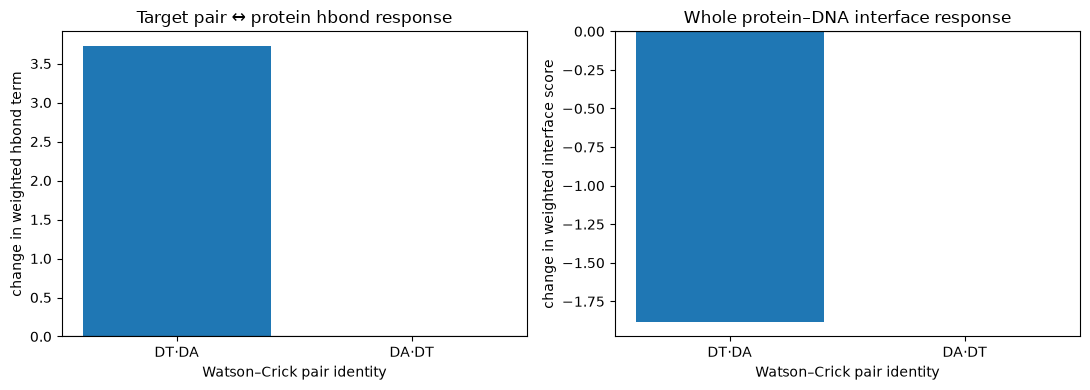
Compare DA·DT with DT·DA. Both cases rebuild the pair with NaChiRotamerSampler, repack the same protein shell, and minimize bases and declared hydroxyl proton-chi hydrogens. Sugar–phosphate atoms and protein main chain stay fixed.
target_pair_protein_hbond and protein_DNA_interaction combine both matrix orientations. protein_DNA_favorable_hbond_block_pairs counts residue pairs with combined weighted hbond < −0.1, not atom-level hydrogen bonds. A(N6)···T(O4) and A(N1)···T(N3) distances check Watson–Crick geometry; clash counts and covalent drift check other distortions.
Task masks: restrict_identities_per_pose() retains original identities elsewhere and intersects the allowed-type mask once. Do not also call restrict_to_repacking(), which would remove the swapped identities. This uses lower-level task fields, not a DNA-specificity protocol.
The chi_sample_level=1 run illustrates local response, not converged specificity. CUDA seeds can probe search variability; CPU’s unexposed C RNG prevents controlled PyTorch-seeded replicates.
[6]:
homeodomain_pose = poses["engrailed homeodomain–DNA — 1HDD"]
DNA_NAMES = {"DA", "DC", "DG", "DT"}
dna_mask = block_mask_for_name3(homeodomain_pose, DNA_NAMES)
real_mask = homeodomain_pose.block_type_ind >= 0
protein_mask = real_mask & ~dna_mask

block_scorer = score_function.render_block_pair_scoring_module(homeodomain_pose)
by_term = block_scorer(
    homeodomain_pose.coords, sum_terms=False, apply_weights=True
)
hbond_index = score_function.all_score_types().index(ScoreType.hbond)
hbond_matrix = by_term[hbond_index, 0]
protein_blocks = torch.nonzero(protein_mask[0], as_tuple=False).flatten()
chain_labels = np.asarray(homeodomain_pose.pdb_info.chain_labels[0]).astype(str)
residue_labels = np.asarray(homeodomain_pose.pdb_info.residue_labels[0]).astype(str)
core_adenine_mask = (
    dna_mask[0]
    & block_mask_for_name3(homeodomain_pose, {"DA"})[0]
    & torch.as_tensor(
        (chain_labels == "A") & np.isin(residue_labels, ["12", "13"]),
        device=device,
    )
)
core_adenines = torch.nonzero(core_adenine_mask, as_tuple=False).flatten()
if len(core_adenines) != 2:
    raise RuntimeError("Expected the two adenines in the 1HDD TAAT subsite")
target_hbond_scores = torch.stack(
    [
        hbond_matrix[block_index, protein_blocks].sum()
        + hbond_matrix[protein_blocks, block_index].sum()
        for block_index in core_adenines
    ]
)
target_block = int(core_adenines[torch.argmin(target_hbond_scores)].item())
target_name3 = homeodomain_pose.block_type(0, target_block).name3
target_chain = str(homeodomain_pose.pdb_info.chain_labels[0, target_block])
target_residue = str(homeodomain_pose.pdb_info.residue_labels[0, target_block])
if target_name3 != "DA":
    raise RuntimeError(f"Expected target DA, found {target_name3}")

opposite_thymine_mask = (
    dna_mask[0]
    & block_mask_for_name3(homeodomain_pose, {"DT"})[0]
    & torch.as_tensor(chain_labels != target_chain, device=device)
)
opposite_thymines = torch.nonzero(
    opposite_thymine_mask, as_tuple=False
).flatten()
if len(opposite_thymines) == 0:
    raise RuntimeError("No opposite-strand DT candidates were found")
target_to_thymine_hbond = (
    hbond_matrix[target_block, opposite_thymines]
    + hbond_matrix[opposite_thymines, target_block]
)
paired_block = int(
    opposite_thymines[torch.argmin(target_to_thymine_hbond)].item()
)
paired_name3 = homeodomain_pose.block_type(0, paired_block).name3
paired_chain = str(homeodomain_pose.pdb_info.chain_labels[0, paired_block])
paired_residue = str(homeodomain_pose.pdb_info.residue_labels[0, paired_block])
assert paired_name3 == "DT" and paired_chain != target_chain
paired_hbond_score = float(target_to_thymine_hbond.min().detach().cpu())
print(
    f"selected pair: block {target_block} chain {target_chain} residue "
    f"{target_residue} {target_name3} · block {paired_block} chain "
    f"{paired_chain} residue {paired_residue} {paired_name3}; "
    f"two-orientation pair hbond {paired_hbond_score:.3f}"
)

centroids, radii = compute_block_centroids_and_furthest_dist(homeodomain_pose)
adjacency = compute_block_adjacency(centroids, radii)
local_blocks = (
    adjacency[:, target_block] | adjacency[:, paired_block]
).clone()
local_blocks[:, target_block] = True
local_blocks[:, paired_block] = True
local_protein_blocks = local_blocks & protein_mask
show_table(
    pd.DataFrame(
        [
            {
                "target_DA": f"{target_chain}:{target_residue}",
                "paired_DT": f"{paired_chain}:{paired_residue}",
                "pair_selection_metric": "two-orientation weighted hbond",
                "pair_hbond_score": paired_hbond_score,
                "shared_nearby_protein_blocks": int(local_protein_blocks.sum()),
            }
        ]
    )
)
selected pair: block 12 chain A residue 13 DA · block 30 chain B residue 31 DT; two-orientation pair hbond -2.560
[7]:
def restrict_identities_per_pose(task, requested_names_by_block):
    """Apply all per-pose identity requests in one monotonic intersection."""
    keep = task.per_block_considered_block_types_is_orig.detach().clone()
    considered = task.per_block_considered_block_types
    for block_index, names in requested_names_by_block.items():
        if len(names) != task.per_block_is_block_type_allowed.shape[0]:
            raise ValueError("Each identity list must contain one name per pose")
        for pose_index, name3 in enumerate(names):
            considered_here = considered[
                pose_index, block_index
            ].detach().cpu().tolist()
            requested = torch.tensor(
                [
                    index >= 0
                    and task.pbt.active_block_types[index].name3 == name3
                    for index in considered_here
                ],
                dtype=torch.bool,
                device=task.device,
            )
            if not torch.any(requested):
                raise ValueError(
                    f"{name3} is not available at block {block_index}"
                )
            keep[pose_index, block_index] = requested
    task.per_block_is_block_type_allowed = torch.logical_and(
        task.per_block_is_block_type_allowed, keep
    )


def add_protein_and_na_samplers(task):
    task.add_conformer_sampler(
        create_dunbrack_sampler_from_database(param_db, device)
    )
    task.add_conformer_sampler(FixedAAChiSampler())
    task.add_conformer_sampler(
        NaChiRotamerSampler.from_database(param_db, device, chi_sample_level=1)
    )
    task.add_conformer_sampler(IncludeCurrentSampler())


variant_labels = ["DA·DT", "DT·DA"]
target_variants = ["DA", "DT"]
paired_variants = ["DT", "DA"]
mutation_batch = PoseStackBuilder.from_poses(
    [homeodomain_pose] * len(variant_labels), device
)
mutation_task = PackerTask(mutation_batch, PackerPalette())
restrict_identities_per_pose(
    mutation_task,
    {
        target_block: target_variants,
        paired_block: paired_variants,
    },
)
# Do not call restrict_to_repacking(): it would intersect away swapped identities.
non_pair = torch.ones(
    mutation_batch.max_n_blocks, dtype=torch.bool, device=device
)
non_pair[[target_block, paired_block]] = False
assert torch.equal(
    mutation_task.per_block_is_block_type_allowed[:, non_pair],
    mutation_task.per_block_considered_block_types_is_orig[:, non_pair],
)
for block_index, requested_names in {
    target_block: target_variants,
    paired_block: paired_variants,
}.items():
    for pose_index, requested_name3 in enumerate(requested_names):
        considered = mutation_task.per_block_considered_block_types[
            pose_index, block_index
        ]
        allowed = mutation_task.per_block_is_block_type_allowed[
            pose_index, block_index
        ]
        allowed_name3s = {
            mutation_task.pbt.active_block_types[int(block_type_index)].name3
            for block_type_index in considered[allowed].detach().cpu().tolist()
            if block_type_index >= 0
        }
        assert allowed_name3s == {requested_name3}

local_design_region = local_protein_blocks.clone()
local_design_region[:, target_block] = True
local_design_region[:, paired_block] = True
packing_region = local_design_region.expand(len(variant_labels), -1).clone()
mutation_task.disable_packing_by_block_mask(~packing_region)
add_protein_and_na_samplers(mutation_task)

torch.manual_seed(SEED)
packed_variants = pack_rotamers(mutation_batch, score_function, mutation_task)

# Minimize both bases/proton-chi atoms plus the same nearby protein shell.
# The nucleotide sugar-phosphates and protein main chain remain fixed.
pair_by_pose = torch.zeros_like(
    packed_variants.block_type_ind, dtype=torch.bool
)
pair_by_pose[:, target_block] = True
pair_by_pose[:, paired_block] = True
protein_region = local_protein_blocks.expand(len(variant_labels), -1)
na_coord_mask = build_na_base_and_proton_chi_coord_mask(
    packed_variants, pair_by_pose
)
protein_coord_mask = build_sidechain_coord_mask(
    packed_variants
) & res_mask_to_coord_mask(packed_variants, protein_region)
coord_mask = na_coord_mask | protein_coord_mask
show_table(
    pd.DataFrame(
        {
            "pair_identity": variant_labels,
            "movable_pair_base_and_proton_chi_atoms": na_coord_mask.sum(dim=1)
            .detach()
            .cpu()
            .numpy(),
            "movable_shared_protein_sidechain_atoms": protein_coord_mask.sum(dim=1)
            .detach()
            .cpu()
            .numpy(),
            "Cartesian_movable_atoms_total": coord_mask.sum(dim=1)
            .detach()
            .cpu()
            .numpy(),
        }
    )
)
try:
    dna_scope_viewer = tmol.view(
        packed_variants.split(0),
        highlighted=coord_mask[0, packed_variants.real_atoms[0]],
        highlight_color="#7b2cbf",
    )
    dna_scope_viewer.show()
except ImportError:
    print("Install py3Dmol to inspect the DNA refinement mask.")

refined_variants = run_cart_min(
    packed_variants,
    score_function,
    coord_mask=coord_mask,
    optimizer_kwargs={"max_iter": 30},
)
3Dmol.js failed to load for some reason. Please check your browser console for error messages.
[8]:
def protein_dna_metrics(pose, target_pair_indices):
    dna = block_mask_for_name3(pose, DNA_NAMES)[0]
    real = pose.block_type_ind[0] >= 0
    protein = real & ~dna
    scorer = score_function.render_block_pair_scoring_module(pose)
    term_matrices = scorer(pose.coords, sum_terms=False, apply_weights=True)[:, 0]
    hbond = term_matrices[hbond_index]
    total = term_matrices.sum(dim=0)
    dna_indices = torch.nonzero(dna, as_tuple=False).flatten()
    protein_indices = torch.nonzero(protein, as_tuple=False).flatten()
    target_pair_indices = torch.as_tensor(
        target_pair_indices, dtype=torch.long, device=pose.device
    )
    pair_hbond = hbond[dna_indices[:, None], protein_indices[None, :]]
    pair_hbond = pair_hbond + hbond[
        protein_indices[:, None], dna_indices[None, :]
    ].T
    cross_total = total[dna_indices[:, None], protein_indices[None, :]].sum()
    cross_total += total[
        protein_indices[:, None], dna_indices[None, :]
    ].sum()
    target_pair_hbond = hbond[
        target_pair_indices[:, None], protein_indices[None, :]
    ].sum()
    target_pair_hbond += hbond[
        protein_indices[:, None], target_pair_indices[None, :]
    ].sum()
    whole_scorer = score_function.render_whole_pose_scoring_module(pose)
    return {
        "total_score": float(whole_scorer(pose.coords).detach().cpu()[0]),
        "protein_DNA_interaction": float(cross_total.detach().cpu()),
        "protein_DNA_hbond": float(pair_hbond.sum().detach().cpu()),
        "target_pair_protein_hbond": float(target_pair_hbond.detach().cpu()),
        "protein_DNA_favorable_hbond_block_pairs": int(
            (pair_hbond < -0.1).sum().detach().cpu()
        ),
    }


def watson_crick_distances(pose):
    pair_names = {
        target_block: pose.block_type(0, target_block).name3,
        paired_block: pose.block_type(0, paired_block).name3,
    }
    adenine_blocks = [
        block for block, name3 in pair_names.items() if name3 == "DA"
    ]
    thymine_blocks = [
        block for block, name3 in pair_names.items() if name3 == "DT"
    ]
    if len(adenine_blocks) != 1 or len(thymine_blocks) != 1:
        raise RuntimeError(f"Expected one DA and one DT, found {pair_names}")
    adenine_block = adenine_blocks[0]
    thymine_block = thymine_blocks[0]
    return {
        "A_N6_donor_to_T_O4_acceptor_A": named_atom_distance(
            pose, adenine_block, "N6", thymine_block, "O4"
        ),
        "A_N1_acceptor_to_T_N3_donor_A": named_atom_distance(
            pose, adenine_block, "N1", thymine_block, "N3"
        ),
    }


variant_poses = {}
variant_rows = []
watson_crick_rows = []
for pose_index, variant_label in enumerate(variant_labels):
    packed_variant = packed_variants.split(pose_index)
    variant_pose = refined_variants.split(pose_index)
    variant_poses[variant_label] = variant_pose
    assert packed_variant.block_type(0, target_block).name3 == target_variants[
        pose_index
    ]
    assert packed_variant.block_type(0, paired_block).name3 == paired_variants[
        pose_index
    ]
    for stage, pose in (
        ("packed; before Cartesian minimization", packed_variant),
        ("after Cartesian minimization", variant_pose),
    ):
        watson_crick_rows.append(
            {
                "pair_identity": variant_label,
                "stage": stage,
                **watson_crick_distances(pose),
            }
        )
    variant_dna = block_mask_for_name3(variant_pose, DNA_NAMES)
    variant_protein = (variant_pose.block_type_ind >= 0) & ~variant_dna
    geometry = interface_geometry_diagnostics(
        variant_pose, variant_dna, variant_protein
    )
    geometry.update(
        bond_length_change_diagnostics(
            packed_variant,
            variant_pose,
            coord_mask[pose_index : pose_index + 1],
        )
    )
    variant_rows.append(
        {
            "pair_identity": variant_label,
            **protein_dna_metrics(
                variant_pose, [target_block, paired_block]
            ),
            **geometry,
        }
    )

watson_crick_frame = pd.DataFrame(watson_crick_rows)
show_table(watson_crick_frame)

mutation_frame = pd.DataFrame(variant_rows)
reference = mutation_frame.loc[
    mutation_frame["pair_identity"] == "DA·DT"
].iloc[0]
for metric in (
    "total_score",
    "protein_DNA_interaction",
    "protein_DNA_hbond",
    "target_pair_protein_hbond",
):
    mutation_frame[f"delta_{metric}"] = mutation_frame[metric] - reference[metric]
if mutation_frame["delta_total_score"].abs().max() > 100:
    raise RuntimeError(
        "The local refinement changed the total score by more than 100 units; "
        "inspect the model before interpreting interface metrics."
    )
mutation_frame["score_sanity_check"] = "passed"
mutation_frame = mutation_frame.sort_values(
    "delta_target_pair_protein_hbond", ascending=False
)
show_table(mutation_frame)

fig, axes = plt.subplots(1, 2, figsize=(11, 4))
axes[0].bar(
    mutation_frame["pair_identity"],
    mutation_frame["delta_target_pair_protein_hbond"],
)
axes[0].axhline(0, color="black", linewidth=0.8)
axes[0].set(
    xlabel="Watson–Crick pair identity",
    ylabel="change in weighted hbond term",
    title="Target pair ↔ protein hbond response",
)
axes[1].bar(
    mutation_frame["pair_identity"],
    mutation_frame["delta_protein_DNA_interaction"],
)
axes[1].axhline(0, color="black", linewidth=0.8)
axes[1].set(
    xlabel="Watson–Crick pair identity",
    ylabel="change in weighted interface score",
    title="Whole protein–DNA interface response",
)
plt.tight_layout()
plt.show()

display(
    tmol.switchable_view(
        variant_poses,
        notes={
            row["pair_identity"]: (
                f"pair/protein hbond Δ "
                f"{row['delta_target_pair_protein_hbond']:+.3f}; "
                f"interface Δ {row['delta_protein_DNA_interaction']:+.3f}"
            )
            for _, row in mutation_frame.iterrows()
        },
    )
)
| Loading ITables v2.9.1 from the internet... (need help?) |
| ⓘpair_identity | stage | A_N6_donor_to_T_O4_acceptor_A | A_N1_acceptor_to_T_N3_donor_A |
|---|---|---|---|
| DA·DT | packed; before Cartesian minimization | 2.751767 | 2.721353 |
| DA·DT | after Cartesian minimization | 2.996170 | 2.719429 |
| DT·DA | packed; before Cartesian minimization | 2.866482 | 2.912271 |
| DT·DA | after Cartesian minimization | 2.808601 | 2.712232 |
| Loading ITables v2.9.1 from the internet... (need help?) |
| ⓘpair_identity | total_score | protein_DNA_interaction | protein_DNA_hbond | target_pair_protein_hbond | protein_DNA_favorable_hbond_block_pairs | minimum_intergroup_heavy_atom_distance_A | intergroup_heavy_atom_pairs_below_2A | covalent_bonds_touching_movable_atoms | bond_length_RMS_change_A | maximum_absolute_bond_length_change_A | delta_total_score | delta_protein_DNA_interaction | delta_protein_DNA_hbond | delta_target_pair_protein_hbond | score_sanity_check |
|---|---|---|---|---|---|---|---|---|---|---|---|---|---|---|---|
| DT·DA | 1694.911133 | -104.015228 | -13.710621 | 0.000000 | 10 | 2.433791 | 0 | 373 | 0.020785 | 0.088716 | 6.839844 | 0.043961 | 3.371183 | 3.126665 | passed |
| DA·DT | 1688.071289 | -104.059189 | -17.081804 | -3.126665 | 11 | 2.410508 | 0 | 373 | 0.021951 | 0.125741 | 0.000000 | 0.000000 | 0.000000 | 0.000000 | passed |
3Dmol.js failed to load for some reason. Please check your browser console for error messages.
3Dmol.js failed to load for some reason. Please check your browser console for error messages.
Positive score deltas favor the equivalently refined starting pair under that component. Repeat sampling and starting structures before interpreting sequence preference.
RNA aptamer with a fixed ligand#
1EHT contains explicit TEP bonds and hydrogens. prepare_ligands=True returns the extended database in the build context. Disable TEP in the task, pack nearby RNA chi candidates, and minimize bases/proton-chi atoms. Sugar–phosphate heavy atoms, sugar-bound carbon hydrogens, and theophylline remain fixed; a coordinate assertion checks the ligand.
For annotated pocket residues U6, A7, C8, C22, U24, and A28, find each nearest base-heavy-atom contact to TEP and track the same atom pair after refinement. These distances, interface contacts, and covalent drift describe pocket geometry; they do not classify hydrogen bonds or sample ligand poses.
[9]:
from openbabel import openbabel as ob

aptamer_array = atom_arrays["theophylline RNA aptamer — 1EHT"]
openbabel_output_level = ob.obErrorLog.GetOutputLevel()
ob.obErrorLog.SetOutputLevel(ob.obError)
try:
    aptamer_pose, aptamer_context = build_pose(
        aptamer_array, prepare_ligands=True, return_context=True
    )
finally:
    ob.obErrorLog.SetOutputLevel(openbabel_output_level)
aptamer_sfxn = beta2016_score_function(
    device, param_db=aptamer_context.parameter_database
)
ligand_mask = block_mask_for_name3(aptamer_pose, {"TEP"})
rna_mask = block_mask_for_name3(aptamer_pose, {"A", "C", "G", "U"})
if int(ligand_mask.sum()) != 1:
    raise RuntimeError("Expected exactly one TEP ligand block")
ligand_block = int(torch.nonzero(ligand_mask[0], as_tuple=False)[0])

centroids, radii = compute_block_centroids_and_furthest_dist(aptamer_pose)
aptamer_adjacency = compute_block_adjacency(centroids, radii)
pocket_rna = aptamer_adjacency[:, ligand_block] & rna_mask

aptamer_task = PackerTask(aptamer_pose, PackerPalette())
aptamer_task.restrict_to_repacking()
aptamer_task.disable_packing_by_block_mask(~pocket_rna)
aptamer_task.add_conformer_sampler(
    NaChiRotamerSampler.from_database(
        aptamer_context.parameter_database,
        device,
        chi_sample_level=1,
        sample_syn=True,
    )
)
aptamer_task.add_conformer_sampler(IncludeCurrentSampler())

torch.manual_seed(SEED)
packed_aptamer = pack_rotamers(aptamer_pose, aptamer_sfxn, aptamer_task)
aptamer_coord_mask = build_na_base_and_proton_chi_coord_mask(
    packed_aptamer, pocket_rna
)
movable_ligand_atoms = int(
    (
        aptamer_coord_mask
        & res_mask_to_coord_mask(packed_aptamer, ligand_mask)
    )
    .sum()
    .item()
)
assert movable_ligand_atoms == 0
show_table(
    pd.DataFrame(
        [
            {
                "RNA_pocket_blocks": int(pocket_rna.sum().item()),
                "Cartesian_movable_RNA_base_and_proton_chi_atoms": int(
                    aptamer_coord_mask.sum().item()
                ),
                "movable_ligand_atoms": movable_ligand_atoms,
            }
        ]
    )
)
try:
    aptamer_scope_viewer = tmol.view(
        packed_aptamer,
        highlighted=aptamer_coord_mask[0, packed_aptamer.real_atoms[0]],
        highlight_color="#7b2cbf",
    )
    aptamer_scope_viewer.show()
except ImportError:
    print("Install py3Dmol to inspect the RNA refinement mask.")

refined_aptamer = run_cart_min(
    packed_aptamer,
    aptamer_sfxn,
    coord_mask=aptamer_coord_mask,
    optimizer_kwargs={"max_iter": 10},
)


def ligand_rna_metrics(pose):
    ligand = block_mask_for_name3(pose, {"TEP"})[0]
    rna = block_mask_for_name3(pose, {"A", "C", "G", "U"})[0]
    scorer = aptamer_sfxn.render_block_pair_scoring_module(pose)
    matrices = scorer(pose.coords, sum_terms=False, apply_weights=True)[:, 0]
    hb_index = aptamer_sfxn.all_score_types().index(ScoreType.hbond)
    ligand_indices = torch.nonzero(ligand, as_tuple=False).flatten()
    rna_indices = torch.nonzero(rna, as_tuple=False).flatten()
    total = matrices.sum(dim=0)
    interaction = total[ligand_indices[:, None], rna_indices[None, :]].sum()
    interaction += total[rna_indices[:, None], ligand_indices[None, :]].sum()
    hbond = matrices[hb_index]
    hbond_interaction = hbond[ligand_indices[:, None], rna_indices[None, :]].sum()
    hbond_interaction += hbond[rna_indices[:, None], ligand_indices[None, :]].sum()
    return float(interaction.detach().cpu()), float(hbond_interaction.detach().cpu())


interaction_before, hbond_before = ligand_rna_metrics(aptamer_pose)
interaction_after, hbond_after = ligand_rna_metrics(refined_aptamer)
ligand_coord_mask = res_mask_to_coord_mask(aptamer_pose, ligand_mask)
ligand_coords_before = aptamer_pose.coords[ligand_coord_mask]
ligand_coords_after = refined_aptamer.coords[ligand_coord_mask]
ligand_motion = float(
    torch.linalg.vector_norm(ligand_coords_after - ligand_coords_before, dim=-1)
    .max()
    .detach()
    .cpu()
)
if ligand_motion > 1e-3:
    raise RuntimeError(
        f"The fixed TEP ligand moved by {ligand_motion:.6f} Å; check the coordinate mask"
    )
input_geometry = interface_geometry_diagnostics(
    aptamer_pose, ligand_mask, rna_mask
)
refined_geometry = interface_geometry_diagnostics(
    refined_aptamer, ligand_mask, rna_mask
)
bond_geometry = bond_length_change_diagnostics(
    aptamer_pose, refined_aptamer, aptamer_coord_mask
)

# The deposited _struct_site_gen table names these six recognition-pocket residues.
recognition_site = {
    "6": "U",
    "7": "A",
    "8": "C",
    "22": "C",
    "24": "U",
    "28": "A",
}
aptamer_chain_labels = np.asarray(
    aptamer_pose.pdb_info.chain_labels[0]
).astype(str)
aptamer_residue_labels = np.asarray(
    aptamer_pose.pdb_info.residue_labels[0]
).astype(str)
aptamer_elements = {
    atom_type.name: atom_type.element
    for atom_type in aptamer_context.parameter_database.chemical.atom_types
}
ligand_heavy_names = [
    atom.name
    for atom in aptamer_pose.block_type(0, ligand_block).atoms
    if aptamer_elements.get(atom.atom_type) != "H"
]
recognition_contact_rows = []
for residue_label, expected_name3 in recognition_site.items():
    candidates = torch.nonzero(
        rna_mask[0]
        & torch.as_tensor(
            (aptamer_chain_labels == "A")
            & (aptamer_residue_labels == residue_label),
            device=device,
        ),
        as_tuple=False,
    ).flatten()
    if len(candidates) != 1:
        raise RuntimeError(
            f"Expected one annotated RNA residue A:{residue_label}"
        )
    rna_block = int(candidates[0])
    observed_name3 = aptamer_pose.block_type(0, rna_block).name3
    if observed_name3 != expected_name3:
        raise RuntimeError(
            f"A:{residue_label} is {observed_name3}, expected {expected_name3}"
        )
    rna_heavy_names = [
        atom.name
        for atom in aptamer_pose.block_type(0, rna_block).atoms
        if aptamer_elements.get(atom.atom_type) != "H"
        and "'" not in atom.name
        and atom.name != "P"
        and not atom.name.startswith("OP")
        and not (atom.name.startswith("O") and atom.name.endswith("P"))
    ]
    if not rna_heavy_names:
        raise RuntimeError(f"No named base heavy atoms for A:{residue_label}")
    named_pairs = [
        (
            named_atom_distance(
                aptamer_pose,
                rna_block,
                rna_atom,
                ligand_block,
                ligand_atom,
            ),
            rna_atom,
            ligand_atom,
        )
        for rna_atom in rna_heavy_names
        for ligand_atom in ligand_heavy_names
    ]
    input_distance, rna_atom, ligand_atom = min(named_pairs)
    refined_distance = named_atom_distance(
        refined_aptamer,
        rna_block,
        rna_atom,
        ligand_block,
        ligand_atom,
    )
    recognition_contact_rows.append(
        {
            "annotated_RNA_residue": (
                f"A:{residue_label} {observed_name3}"
            ),
            "RNA_atom": rna_atom,
            "TEP_atom": ligand_atom,
            "input_distance_A": input_distance,
            "refined_same_pair_distance_A": refined_distance,
            "input_direct_contact_le_4A": input_distance <= 4.0,
        }
    )
recognition_contact_frame = pd.DataFrame(recognition_contact_rows)
show_table(recognition_contact_frame)

aptamer_frame = pd.DataFrame(
    [
        {
            "stage": "input",
            "RNA_TEP_interaction": interaction_before,
            "RNA_TEP_hbond": hbond_before,
            "max_ligand_motion_A": 0.0,
            **input_geometry,
            "bond_length_RMS_change_from_input_A": 0.0,
            "maximum_absolute_bond_length_change_from_input_A": 0.0,
        },
        {
            "stage": "RNA repacked + minimized; TEP fixed",
            "RNA_TEP_interaction": interaction_after,
            "RNA_TEP_hbond": hbond_after,
            "max_ligand_motion_A": ligand_motion,
            **refined_geometry,
            "bond_length_RMS_change_from_input_A": bond_geometry[
                "bond_length_RMS_change_A"
            ],
            "maximum_absolute_bond_length_change_from_input_A": bond_geometry[
                "maximum_absolute_bond_length_change_A"
            ],
        },
    ]
)
show_table(aptamer_frame)
display(
    tmol.switchable_view(
        {"input aptamer": aptamer_pose, "refined RNA pocket": refined_aptamer},
        notes={
            "input aptamer": f"RNA–TEP interaction {interaction_before:.3f}",
            "refined RNA pocket": (
                f"RNA–TEP interaction {interaction_after:.3f}; "
                f"max ligand motion {ligand_motion:.6f} Å"
            ),
        },
    )
)
3Dmol.js failed to load for some reason. Please check your browser console for error messages.
| Loading ITables v2.9.1 from the internet... (need help?) |
| ⓘannotated_RNA_residue | RNA_atom | TEP_atom | input_distance_A | refined_same_pair_distance_A | input_direct_contact_le_4A |
|---|---|---|---|---|---|
| A:6 U | N1 | O6 | 4.809463 | 4.733184 | False |
| A:7 A | N3 | N7 | 3.862420 | 3.691880 | True |
| A:8 C | N4 | N9 | 3.030400 | 3.193948 | True |
| A:22 C | O2 | N7 | 3.278871 | 2.969578 | True |
| A:24 U | N3 | N9 | 3.161967 | 3.037850 | True |
| A:28 A | N7 | N9 | 2.812465 | 3.082725 | True |
| Loading ITables v2.9.1 from the internet... (need help?) |
| ⓘstage | RNA_TEP_interaction | RNA_TEP_hbond | max_ligand_motion_A | minimum_intergroup_heavy_atom_distance_A | intergroup_heavy_atom_pairs_below_2A | bond_length_RMS_change_from_input_A | maximum_absolute_bond_length_change_from_input_A |
|---|---|---|---|---|---|---|---|
| input | -20.693245 | -0.610405 | 0.0 | 2.798442 | 0 | 0.000000 | 0.000000 |
| RNA repacked + minimized; TEP fixed | -26.534740 | -2.747346 | 0.0 | 2.798442 | 0 | 0.018156 | 0.053307 |
3Dmol.js failed to load for some reason. Please check your browser console for error messages.
3Dmol.js failed to load for some reason. Please check your browser console for error messages.
Score the 1EHT NMR ensemble#
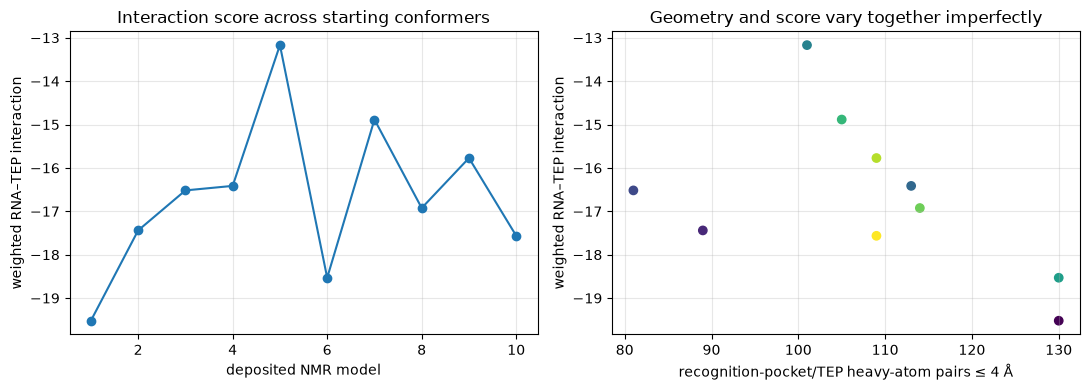
Score all ten deposited models without refinement. Reuse model 1’s ligand-aware context for models 2–10 and combine them in one PoseStack.
Report both-orientation RNA–TEP interaction and hbond scores, nearest pocket distance, and pocket–ligand heavy-atom pairs within 4 Å. Model numbers are labels, not time coordinates or statistical weights.
[10]:
aptamer_ensemble_arrays = load_structure(
    str(cif_paths["theophylline RNA aptamer — 1EHT"]),
    include_bonds=True,
)
if aptamer_ensemble_arrays.stack_depth() != 10:
    raise RuntimeError("Expected ten deposited 1EHT NMR models")
ensemble_poses = [aptamer_pose]
for model_index in range(1, aptamer_ensemble_arrays.stack_depth()):
    diagnostics = StringIO()
    try:
        with redirect_stdout(diagnostics), redirect_stderr(diagnostics):
            ensemble_poses.append(
                pose_stack_from_biotite(
                    aptamer_ensemble_arrays[model_index],
                    device,
                    context=aptamer_context,
                    no_optH=True,
                )
            )
    except Exception:
        print(diagnostics.getvalue())
        raise

aptamer_ensemble = PoseStackBuilder.from_poses(ensemble_poses, device)
ensemble_ligand = block_mask_for_name3(aptamer_ensemble, {"TEP"})
ensemble_rna = block_mask_for_name3(aptamer_ensemble, {"A", "C", "G", "U"})
ensemble_pair_mask = (ensemble_ligand[:, :, None] & ensemble_rna[:, None, :]) | (
    ensemble_rna[:, :, None] & ensemble_ligand[:, None, :]
)
ensemble_scorer = aptamer_sfxn.render_block_pair_scoring_module(aptamer_ensemble)
with torch.no_grad():
    ensemble_matrices = ensemble_scorer(
        aptamer_ensemble.coords,
        sum_terms=False,
        apply_weights=True,
    )
ensemble_interactions = (ensemble_matrices.sum(dim=0) * ensemble_pair_mask).sum(
    dim=(1, 2)
)
ensemble_hbond_index = aptamer_sfxn.all_score_types().index(ScoreType.hbond)
ensemble_hbonds = (ensemble_matrices[ensemble_hbond_index] * ensemble_pair_mask).sum(
    dim=(1, 2)
)

ensemble_elements = {
    atom_type.name: atom_type.element
    for atom_type in aptamer_context.parameter_database.chemical.atom_types
}


def heavy_coordinate_indices(pose, pose_index, block_mask):
    """Return coordinate indices for heavy atoms in selected blocks."""
    indices = []
    pose_block_mask = (
        block_mask[pose_index] if block_mask.ndim == 2 else block_mask
    )
    for block_index in (
        torch.nonzero(pose_block_mask, as_tuple=False).flatten().tolist()
    ):
        block_type = pose.block_type(pose_index, block_index)
        offset = int(pose.block_coord_offset64[pose_index, block_index])
        indices.extend(
            offset + atom_index
            for atom_index, atom in enumerate(block_type.atoms)
            if ensemble_elements.get(atom.atom_type) != "H"
        )
    return torch.as_tensor(indices, device=device, dtype=torch.long)


ensemble_rows = []
recognition_labels = set(recognition_site)
for pose_index in range(aptamer_ensemble.n_poses):
    chain_labels = np.asarray(
        aptamer_ensemble.pdb_info.chain_labels[pose_index]
    ).astype(str)
    residue_labels = np.asarray(
        aptamer_ensemble.pdb_info.residue_labels[pose_index]
    ).astype(str)
    recognition_blocks = ensemble_rna[pose_index] & torch.as_tensor(
        (chain_labels == "A") & np.isin(residue_labels, list(recognition_labels)),
        device=device,
    )
    ligand_indices = heavy_coordinate_indices(
        aptamer_ensemble, pose_index, ensemble_ligand
    )
    pocket_indices = heavy_coordinate_indices(
        aptamer_ensemble, pose_index, recognition_blocks
    )
    distances = torch.cdist(
        aptamer_ensemble.coords[pose_index, ligand_indices],
        aptamer_ensemble.coords[pose_index, pocket_indices],
    )
    ensemble_rows.append(
        {
            "NMR_model": pose_index + 1,
            "RNA_TEP_interaction": float(
                ensemble_interactions[pose_index].detach().cpu()
            ),
            "RNA_TEP_hbond": float(ensemble_hbonds[pose_index].detach().cpu()),
            "closest_recognition_pocket_heavy_distance_A": float(
                distances.min().detach().cpu()
            ),
            "recognition_pocket_heavy_pairs_le_4A": int(
                (distances <= 4.0).sum().item()
            ),
        }
    )

ensemble_frame = pd.DataFrame(ensemble_rows)
show_table(ensemble_frame)

fig, axes = plt.subplots(1, 2, figsize=(11, 4))
axes[0].plot(
    ensemble_frame["NMR_model"],
    ensemble_frame["RNA_TEP_interaction"],
    marker="o",
)
axes[0].set(
    xlabel="deposited NMR model",
    ylabel="weighted RNA–TEP interaction",
    title="Interaction score across starting conformers",
)
axes[1].scatter(
    ensemble_frame["recognition_pocket_heavy_pairs_le_4A"],
    ensemble_frame["RNA_TEP_interaction"],
    c=ensemble_frame["NMR_model"],
    cmap="viridis",
)
axes[1].set(
    xlabel="recognition-pocket/TEP heavy-atom pairs ≤ 4 Å",
    ylabel="weighted RNA–TEP interaction",
    title="Geometry and score vary together imperfectly",
)
for axis in axes:
    axis.grid(alpha=0.3)
plt.tight_layout()
plt.show()

lowest_model = int(ensemble_frame["RNA_TEP_interaction"].idxmin())
highest_model = int(ensemble_frame["RNA_TEP_interaction"].idxmax())
distance_from_median = (
    ensemble_frame["RNA_TEP_interaction"]
    - ensemble_frame["RNA_TEP_interaction"].median()
).abs()
middle_model = int(distance_from_median.idxmin())
selected_models = list(dict.fromkeys([lowest_model, middle_model, highest_model]))
display(
    tmol.switchable_view(
        {
            f"NMR model {index + 1}": aptamer_ensemble.split(index)
            for index in selected_models
        },
        notes={
            f"NMR model {index + 1}": (
                f"RNA–TEP interaction "
                f"{ensemble_frame.loc[index, 'RNA_TEP_interaction']:.3f}; "
                f"contacts ≤4 Å "
                f"{ensemble_frame.loc[index, 'recognition_pocket_heavy_pairs_le_4A']}"
            )
            for index in selected_models
        },
    )
)
| Loading ITables v2.9.1 from the internet... (need help?) |
| ⓘNMR_model | RNA_TEP_interaction | RNA_TEP_hbond | closest_recognition_pocket_heavy_distance_A | recognition_pocket_heavy_pairs_le_4A |
|---|---|---|---|---|
| 1 | -20.693243 | -0.610405 | 2.798442 | 130 |
| 2 | -17.300594 | -1.491261 | 2.668312 | 89 |
| 3 | -16.009113 | 0.000000 | 2.741559 | 81 |
| 4 | -16.304987 | -0.498698 | 2.851621 | 113 |
| 5 | -12.671281 | -0.677436 | 2.766894 | 101 |
| 6 | -18.577614 | -1.409888 | 2.896141 | 130 |
| 7 | -14.786982 | -0.449247 | 2.874888 | 105 |
| 8 | -16.991016 | -0.641026 | 2.969505 | 114 |
| 9 | -15.480539 | -1.087920 | 2.719331 | 109 |
| 10 | -17.590441 | -0.581347 | 3.075090 | 109 |
3Dmol.js failed to load for some reason. Please check your browser console for error messages.
3Dmol.js failed to load for some reason. Please check your browser console for error messages.
3Dmol.js failed to load for some reason. Please check your browser console for error messages.
The ten deposited conformers need not have identical contacts or scores even though their sequence and parameterization match. A favorable interaction value can coexist with a different contact count because the score includes more than distance-threshold contacts. This ensemble measures sensitivity to deposited starting conformations.
Next#
Try protein interface analysis, ligand pose sensitivity, or the task index.
Exercises#
Change the homeodomain target from the strongest protein-hbond-scored adenine to the next-ranked site, identify its paired thymine with the same two-orientation rule, and compare pair swaps.
On CUDA, repeat three PyTorch packer seeds at
chi_sample_level=1; then expand the level only if runtime permits, reporting candidate count, runtime, interface-score spread, and Watson–Crick distance spread. On CPU, do not treat different torch seeds as controlled replicates because the packer uses an unexposed C RNG.Keep both DNA identities fixed and repack only the same nearby protein shell to separate sequence and conformational effects.
In the aptamer, vary the RNA-pocket definition while asserting that TEP coordinates and the named recognition-pocket atom pairs remain unchanged.
Locally refine all ten 1EHT models with one matched protocol, then compare the input ensemble spread with the endpoint spread without treating models as statistical replicates.
References#
Kissinger et al., Crystal structure of an engrailed homeodomain–DNA complex
Zimmermann et al., Interlocking structural motifs mediate molecular discrimination by a theophylline-binding RNA