

Tutorial 11 — Extending chemistry and scoring#

Build a chemistry subset, inspect packed metadata, and change one bonded parameter in a new immutable database. Assumes structure I/O, scoring, and ligand preparation.
A smaller type set changes storage. A modified spring constant changes the energy model and requires independent validation.
Setup#
In Colab, select T4 GPU, then Run all. For local execution, follow the installation guide. Setup installs TMol and downloads the fixtures on first use.
No external structures are downloaded. The examples build a five-residue peptide from sequence using the chemistry shipped with the currently installed TMol release. The setup reports exact package versions and uses the selected CPU or CUDA device.
[1]:
try:
    import google.colab  # noqa: F401
except ImportError:
    IN_COLAB = False
else:
    IN_COLAB = True

if IN_COLAB:
    from urllib.request import urlopen

    exec(
        urlopen(
            "https://raw.githubusercontent.com/uw-ipd/tmol/"
            "master/docs/tutorial/colab_setup.py"
        ).read(),
        globals(),
    )
    setup_colab([])
[2]:
import copy

import attrs
import matplotlib.pyplot as plt
import numpy as np
import pandas as pd
import torch
from IPython.display import display

import tmol
from tmol.chemical import ResidueTypeSet
from tmol.database import ParameterDatabase
from tmol.database.scoring import CartBondedDatabase
from tmol.pose import PackedBlockTypes
from tmol.score import ScoreFunction, ScoreType, beta2016_score_function

SEED = 20260910
np.random.seed(SEED)
torch.manual_seed(SEED)
if torch.cuda.is_available():
    torch.cuda.manual_seed_all(SEED)

device = (
    torch.device("cuda", torch.cuda.current_device())
    if torch.cuda.is_available()
    else torch.device("cpu")
)


def show_table(frame):
    """Use a sortable table in rendered docs, with a pandas fallback."""
    try:
        from itables import show
    except ImportError:
        return display(frame)
    return show(frame)


environment_frame = pd.DataFrame(
    [
        {"component": "TMol", "version": tmol.__version__},
        {"component": "PyTorch", "version": torch.__version__},
        {"component": "device", "version": str(device)},
    ]
)
show_table(environment_frame)
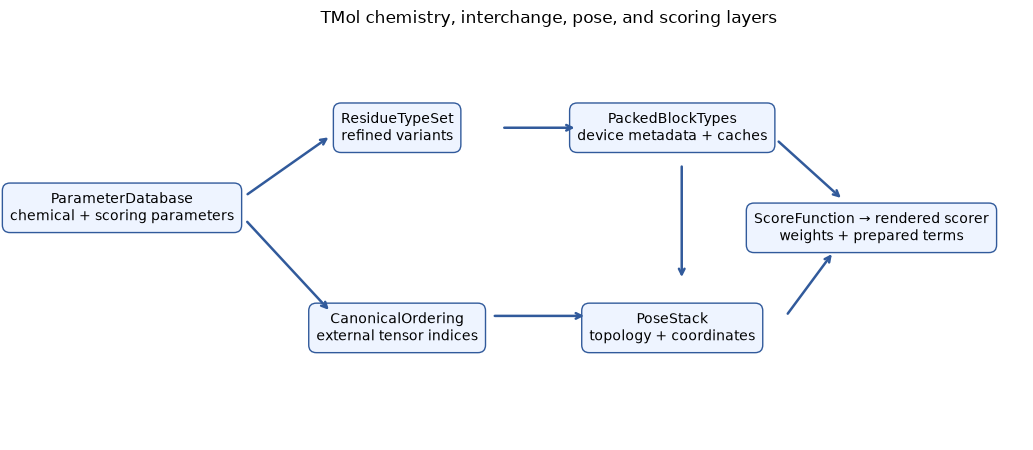
Chemistry, coordinates, and scores#
Object |
Contents |
|---|---|
|
Immutable chemical definitions and scoring parameters |
|
Refined types, including terminal variants |
|
Ordered types and device setup data shared by poses and terms |
|
External tensor indices for residue-equivalence classes and atoms |
|
Term weights and options |
Rendering prepares topology-dependent scoring data. Reuse the layout when only coordinates change. The diagram shows ownership, not call order.
[3]:
fig, ax = plt.subplots(figsize=(10.5, 4.6))
ax.set_axis_off()
boxes = {
    "ParameterDatabase\nchemical + scoring parameters": (0.05, 0.58),
    "ResidueTypeSet\nrefined variants": (0.34, 0.78),
    "CanonicalOrdering\nexternal tensor indices": (0.34, 0.28),
    "PackedBlockTypes\ndevice metadata + caches": (0.63, 0.78),
    "PoseStack\ntopology + coordinates": (0.63, 0.28),
    "ScoreFunction → rendered scorer\nweights + prepared terms": (0.84, 0.53),
}
for label, (x, y) in boxes.items():
    ax.text(
        x,
        y,
        label,
        transform=ax.transAxes,
        ha="center",
        va="center",
        bbox={"boxstyle": "round,pad=0.55", "fc": "#eef4ff", "ec": "#315a9b"},
    )
arrows = [
    ((0.18, 0.61), (0.27, 0.76)),
    ((0.18, 0.55), (0.27, 0.32)),
    ((0.45, 0.78), (0.53, 0.78)),
    ((0.44, 0.31), (0.54, 0.31)),
    ((0.64, 0.69), (0.64, 0.40)),
    ((0.75, 0.31), (0.80, 0.47)),
    ((0.74, 0.75), (0.81, 0.60)),
]
for start, end in arrows:
    ax.annotate("", xy=end, xytext=start, xycoords="axes fraction", arrowprops={"arrowstyle": "->", "lw": 1.8, "color": "#315a9b"})
ax.set_title("TMol chemistry, interchange, pose, and scoring layers", pad=12)
plt.tight_layout()
plt.show()
Inspect the default refined chemistry#
The raw database contains base residue definitions and named patches. Refinement materializes usable block types such as terminal amino acids and nucleic-acid termini. Counting refined types by polymer backbone makes it clear why a general-purpose packed set is larger than the twenty canonical amino acids.
[4]:
parameter_db = ParameterDatabase.get_default()
residue_type_set = ResidueTypeSet.from_database(parameter_db.chemical)


def chemistry_family(residue_type):
    polymer = residue_type.properties.polymer
    if not polymer.is_polymer:
        return "non-polymer"
    if polymer.backbone_type == "alpha":
        return "protein"
    if polymer.backbone_type == "dna":
        return "DNA"
    if polymer.backbone_type == "rna":
        return "RNA"
    return polymer.backbone_type or "other polymer"


inventory_frame = pd.DataFrame(
    [
        {
            "block_type": residue_type.name,
            "name3": residue_type.name3,
            "family": chemistry_family(residue_type),
            "atoms": len(residue_type.atoms),
            "torsions": len(residue_type.torsions),
        }
        for residue_type in residue_type_set.residue_types
    ]
)
family_counts = (
    inventory_frame.groupby("family", as_index=False)
    .size()
    .sort_values("size", ascending=False)
    .rename(columns={"size": "refined_block_types"})
)
show_table(family_counts)

fig, ax = plt.subplots(figsize=(7.5, 3.8))
ax.barh(
    family_counts["family"][::-1],
    family_counts["refined_block_types"][::-1],
    color="#4c78a8",
)
ax.set(
    xlabel="number of refined block types",
    title="Default chemistry after variant refinement",
)
ax.grid(axis="x", alpha=0.25)
plt.tight_layout()
plt.show()
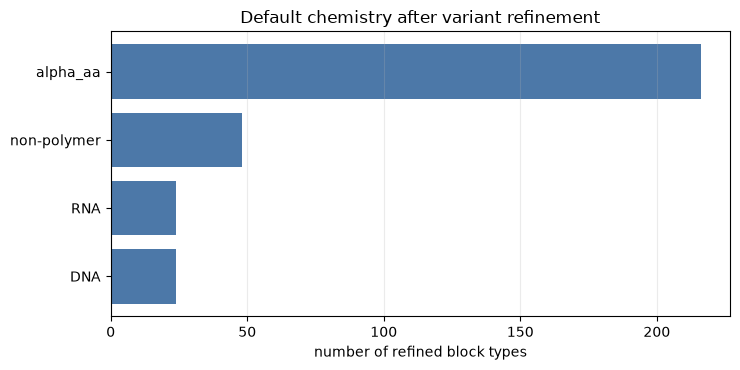
Protein block types dominate the refined inventory because base residues acquire compatible terminal and other variants. These are chemical alternatives, not additional sequence positions. Code that assumes one packed type per one-letter amino-acid code will fail on termini, protonation variants, nucleic acids, and non-polymers.
Build a chemistry subset#
create_stable_subset() selects base names and variants in deterministic order, retaining the full scoring database. Use it only when the complete input alphabet is known.
Keep ALA, GLY, SER, PRO, and protein termini, then build AGSPA to check coverage of its internal and terminal types.
[5]:
subset_db = parameter_db.create_stable_subset(
    desired_names=["ALA", "GLY", "SER", "PRO"],
    desired_variants=["nterm", "cterm"],
)
subset_restype_set = ResidueTypeSet.from_database(subset_db.chemical)
subset_pbt = PackedBlockTypes.from_restype_list(
    subset_db.chemical,
    subset_restype_set,
    subset_restype_set.residue_types,
    device,
)
subset_ordering = tmol.CanonicalOrdering.from_chemdb(subset_db.chemical)
peptide = tmol.extended_pose_stack_from_sequences(
    "AGSPA", device=device, param_db=subset_db
)

subset_frame = pd.DataFrame(
    [
        {
            "context": "default refined chemistry",
            "refined_types": len(residue_type_set.residue_types),
            "packed_types": tmol.default_packed_block_types(device).n_types,
            "canonical_equivalence_classes": tmol.default_canonical_ordering().n_restype_io_equiv_classes,
        },
        {
            "context": "AGSP subset",
            "refined_types": len(subset_restype_set.residue_types),
            "packed_types": subset_pbt.n_types,
            "canonical_equivalence_classes": subset_ordering.n_restype_io_equiv_classes,
        },
    ]
)
show_table(subset_frame)
print("pose block types:", [peptide.block_type(0, i).name for i in range(peptide.max_n_blocks)])

try:
    peptide_viewer = tmol.view(peptide, width=720, height=380)
    peptide_viewer.show()
except ImportError as exc:
    print("Interactive peptide viewer unavailable:", exc)
Environment variable CCD_MIRROR_PATH not set. Will not be able to use function requiring this variable. To set it you may:
  (1) add the line 'export VAR_NAME=path/to/variable' to your .bashrc or .zshrc file
  (2) set it in your current shell with 'export VAR_NAME=path/to/variable'
  (3) write it to a .env file in the root of the atomworks.io repository
Environment variable PDB_MIRROR_PATH not set. Will not be able to use function requiring this variable. To set it you may:
  (1) add the line 'export VAR_NAME=path/to/variable' to your .bashrc or .zshrc file
  (2) set it in your current shell with 'export VAR_NAME=path/to/variable'
  (3) write it to a .env file in the root of the atomworks.io repository
pose block types: ['ALA:nterm', 'GLY', 'SER', 'PRO', 'ALA:cterm']
3Dmol.js failed to load for some reason. Please check your browser console for error messages.
The smaller set builds a complete terminated peptide from ideal internal geometry. An extended structure does not establish folding or validate the energy model.
Separate score weights from score parameters#
Use weights when an existing energy term should contribute differently. Use a modified ParameterDatabase only when the term’s underlying model changes. The focused score function below gives only Cartesian bond-length energy a nonzero weight. Cartesian length, angle, torsion, improper, and hydroxyl-torsion lanes share one implementation term, so rendering it exposes all five lanes even when four weights are zero. Setting every lane owned by a term to zero removes that implementation term.
[6]:
beta = beta2016_score_function(device, param_db=subset_db)
focused = ScoreFunction(subset_db, device)
focused.set_weight(ScoreType.cart_lengths, 1.0)

weight_rows = []
for score_type in beta.all_score_types():
    weight = float(beta.get_weight(score_type).detach().cpu())
    if weight != 0.0:
        weight_rows.append(
            {"score_type": score_type.name, "beta2016_weight": weight}
        )
weight_frame = pd.DataFrame(weight_rows)
weight_frame["focused_cart_length_weight"] = weight_frame["score_type"].map(
    {"cart_lengths": 1.0}
).fillna(0.0)
show_table(weight_frame)
focused_nonzero = [
    score_type
    for score_type in focused.all_score_types()
    if float(focused.get_weight(score_type).detach().cpu()) != 0.0
]
print("focused rendered score lanes:", [st.name for st in focused.all_score_types()])
print("focused nonzero weights:", [st.name for st in focused_nonzero])
assert focused_nonzero == [ScoreType.cart_lengths]
| Loading ITables v2.9.1 from the internet... (need help?) |
| ⓘscore_type | beta2016_weight | focused_cart_length_weight |
|---|---|---|
| fa_ljatr | 1.00 | 0.0 |
| fa_ljrep | 0.55 | 0.0 |
| fa_lk | 1.00 | 0.0 |
| fa_elec | 1.00 | 0.0 |
| hbond | 1.00 | 0.0 |
| cart_lengths | 0.50 | 1.0 |
| cart_angles | 0.50 | 0.0 |
| cart_torsions | 0.50 | 0.0 |
| cart_impropers | 0.50 | 0.0 |
| cart_hxltorsions | 1.00 | 0.0 |
| (15 more rows not shown) | ||
focused rendered score lanes: ['cart_lengths', 'cart_angles', 'cart_torsions', 'cart_impropers', 'cart_hxltorsions']
focused nonzero weights: ['cart_lengths']
Change one immutable Cartesian bonded parameter#
This extension-level example doubles the spring constant for the intraproline N–CD bond. attrs.evolve() and CartBondedDatabase.from_cartres_dict() create new immutable database layers; the shared default remains untouched.
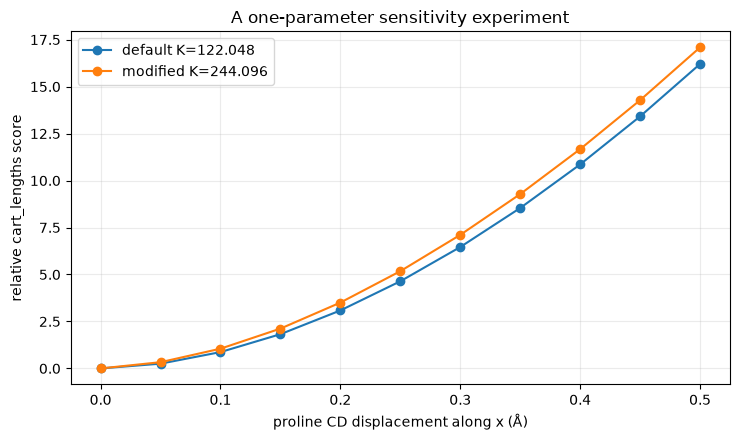
To isolate the change, the code displaces only the internal proline CD atom and compares two score functions containing only cart_lengths. Plotting relative energies removes any constant offset. This is a sensitivity test of one implementation change—not parameter fitting, physical calibration, or evidence that the altered model is better.
[7]:
cart_db = subset_db.scoring.cartbonded
pro_params = cart_db.residue_params["PRO"]
parameter_index, original_n_cd = next(
    (index, parameter)
    for index, parameter in enumerate(pro_params.length_parameters)
    if {parameter.atm1, parameter.atm2} == {"N", "CD"}
)
strengthened_n_cd = attrs.evolve(original_n_cd, K=2.0 * original_n_cd.K)
strengthened_lengths = list(pro_params.length_parameters)
strengthened_lengths[parameter_index] = strengthened_n_cd
strengthened_pro = attrs.evolve(
    pro_params, length_parameters=tuple(strengthened_lengths)
)
strengthened_residue_params = copy.deepcopy(cart_db.residue_params)
strengthened_residue_params["PRO"] = strengthened_pro
strengthened_cart_db = CartBondedDatabase.from_cartres_dict(
    cartres_dict=strengthened_residue_params
)
strengthened_scoring_db = attrs.evolve(
    subset_db.scoring, cartbonded=strengthened_cart_db
)
strengthened_db = attrs.evolve(subset_db, scoring=strengthened_scoring_db)

standard_cart = ScoreFunction(subset_db, device)
standard_cart.set_weight(ScoreType.cart_lengths, 1.0)
strengthened_cart = ScoreFunction(strengthened_db, device)
strengthened_cart.set_weight(ScoreType.cart_lengths, 1.0)
standard_scorer = standard_cart.render_whole_pose_scoring_module(peptide)
strengthened_scorer = strengthened_cart.render_whole_pose_scoring_module(peptide)

pro_block = next(
    index
    for index in range(peptide.max_n_blocks)
    if peptide.block_type(0, index).name3 == "PRO"
)
pro_type = peptide.block_type(0, pro_block)
pro_offset = int(peptide.block_coord_offset64[0, pro_block])
pro_cd = pro_offset + pro_type.atom_to_idx["CD"]

displacement_values = np.linspace(0.0, 0.50, 11)
scan_rows = []
displaced_coords = None
for displacement in displacement_values:
    coords = peptide.coords.clone()
    coords[0, pro_cd, 0] += float(displacement)
    if displacement == displacement_values[-1]:
        displaced_coords = coords
    scan_rows.append(
        {
            "CD_x_displacement_A": displacement,
            "standard_cart_lengths": float(standard_scorer(coords).detach().cpu()[0]),
            "strengthened_cart_lengths": float(strengthened_scorer(coords).detach().cpu()[0]),
        }
    )

scan_frame = pd.DataFrame(scan_rows)
for column in ["standard_cart_lengths", "strengthened_cart_lengths"]:
    scan_frame[f"relative_{column}"] = scan_frame[column] - scan_frame[column].iloc[0]
show_table(scan_frame.iloc[[0, 2, 5, 10]])

fig, ax = plt.subplots(figsize=(7.5, 4.5))
ax.plot(
    scan_frame["CD_x_displacement_A"],
    scan_frame["relative_standard_cart_lengths"],
    marker="o",
    label=f"default K={original_n_cd.K:g}",
)
ax.plot(
    scan_frame["CD_x_displacement_A"],
    scan_frame["relative_strengthened_cart_lengths"],
    marker="o",
    label=f"modified K={strengthened_n_cd.K:g}",
)
ax.set(
    xlabel="proline CD displacement along x (Å)",
    ylabel="relative cart_lengths score",
    title="A one-parameter sensitivity experiment",
)
ax.grid(alpha=0.25)
ax.legend()
plt.tight_layout()
plt.show()

assert parameter_db.scoring.cartbonded.residue_params["PRO"].length_parameters != strengthened_pro.length_parameters
assert scan_frame["relative_strengthened_cart_lengths"].iloc[-1] > scan_frame["relative_standard_cart_lengths"].iloc[-1]
| Loading ITables v2.9.1 from the internet... (need help?) |
| ⓘ | CD_x_displacement_A | standard_cart_lengths | strengthened_cart_lengths | relative_standard_cart_lengths | relative_strengthened_cart_lengths |
|---|---|---|---|---|---|
| 0 | 0.00 | 0.619408 | 0.671390 | 0.000000 | 0.000000 |
| 2 | 0.10 | 1.490051 | 1.722580 | 0.870642 | 1.051190 |
| 5 | 0.25 | 5.258331 | 5.847925 | 4.638923 | 5.176534 |
| 10 | 0.50 | 16.821915 | 17.758902 | 16.202506 | 17.087511 |
[8]:
displaced_peptide = attrs.evolve(peptide, coords=displaced_coords)
try:
    display(
        tmol.switchable_view(
            {
                "ideal input": peptide,
                "CD displaced by 0.50 Å": displaced_peptide,
            },
            notes={
                "ideal input": "Subset-built AGSPA peptide",
                "CD displaced by 0.50 Å": "Only the internal proline CD coordinate was translated",
            },
            width=720,
            height=380,
        )
    )
except ImportError as exc:
    print("Interactive comparison unavailable:", exc)
3Dmol.js failed to load for some reason. Please check your browser console for error messages.
3Dmol.js failed to load for some reason. Please check your browser console for error messages.
The modified curve rises more steeply because only the selected spring constant changed. The switcher confirms that the coordinate experiment is local. The absolute curve includes all bond-length deviations in the peptide, so the difference between curves—not either absolute value—is the cleanest diagnostic of this parameter change.
Validation#
Before shipping a custom database:
Keep the source database immutable and construct a derived object.
Build the smallest pose that exercises the modified chemistry.
Compare changed and unchanged parameters explicitly.
Test values and coordinate gradients on CPU and CUDA.
Validate complete scientific workflows separately from local unit tests.
Record parameter provenance.
Exercises#
Add VAL to the stable subset and verify that
AGSPVbuilds without changing the existing packed-type order.Change the focused score function to contain
cart_anglesinstead ofcart_lengths; perturb an angle-defining coordinate and plot the response.Repeat the N–CD scan with gradients enabled and compare
dE/dxbetween the two parameterizations.