

Tutorial 10 — Ligand pose sensitivity#

Displace a crystallographic ligand, score the decoys in one batch, and locally minimize three selected poses. Compare interaction scores with ligand heavy-atom displacement.
Complete ligand preparation first; this notebook reuses its ADA/LG1 fixture and parameters.
Setup#
In Colab, select T4 GPU, then Run all. For local execution, follow the installation guide. Setup installs TMol and downloads the fixtures on first use.
The checked-in CIF and matching .tmol file are the authoritative coordinate and chemical inputs. The notebook runs on CPU or CUDA, initializes NumPy and PyTorch seeds, and uses the fixtures downloaded during Colab setup instead of querying a live structure database.
[1]:
try:
import google.colab # noqa: F401
except ImportError:
IN_COLAB = False
else:
IN_COLAB = True
if IN_COLAB:
from urllib.request import urlopen
exec(
urlopen(
"https://raw.githubusercontent.com/uw-ipd/tmol/"
"master/docs/tutorial/colab_setup.py"
).read(),
globals(),
)
setup_colab(
[
"tmol/tests/data/protein_ligand_test/ada.tmol.nomin.cif",
"tmol/tests/data/protein_ligand_test/ada.xtal-lig.mmff94.tmol",
]
)
[2]:
from contextlib import redirect_stderr, redirect_stdout
from io import StringIO
from pathlib import Path
import warnings
import biotite.structure.io
import matplotlib.pyplot as plt
import numpy as np
import pandas as pd
import torch
from IPython.display import display
import tmol
from tmol.database import ParameterDatabase
from tmol.io import build_context_from_biotite, pose_stack_from_biotite
from tmol.ligand import inject_params_file
from tmol.ops import build_sidechain_coord_mask, res_mask_to_coord_mask
from tmol.optimization import run_cart_min
from tmol.pose import PoseStackBuilder
from tmol.score import beta2016_score_function
SEED = 20260810
np.random.seed(SEED)
torch.manual_seed(SEED)
if torch.cuda.is_available():
torch.cuda.manual_seed_all(SEED)
warnings.filterwarnings(
"ignore", message=r"Sparse invariant checks are implicitly disabled.*"
)
device = (
torch.device("cuda", torch.cuda.current_device())
if torch.cuda.is_available()
else torch.device("cpu")
)
LIGAND_NAME = "LG1"
def show_table(frame):
"""Display a sortable table when available, with a pandas fallback."""
try:
from itables import show
except ImportError:
return display(frame)
return show(frame)
def block_mask_for_name3(pose, name3):
"""Select blocks with one residue name across a PoseStack."""
mask = torch.zeros_like(pose.block_type_ind, dtype=torch.bool)
for pose_index in range(pose.n_poses):
for block_index in range(pose.max_n_blocks):
if int(pose.block_type_ind64[pose_index, block_index]) < 0:
continue
mask[pose_index, block_index] = (
pose.block_type(pose_index, block_index).name3 == name3
)
return mask
def heavy_atom_mask_for_blocks(pose, block_mask):
"""Expand selected blocks to their non-hydrogen coordinate atoms."""
mask = torch.zeros_like(pose.real_atoms)
for pose_index, block_index in torch.nonzero(block_mask, as_tuple=False).tolist():
block_type_index = int(pose.block_type_ind64[pose_index, block_index].item())
block_type = pose.block_type(pose_index, block_index)
offset = int(pose.block_coord_offset64[pose_index, block_index])
n_atoms = len(block_type.atoms)
is_hydrogen = pose.packed_block_types.atom_is_hydrogen[
block_type_index, :n_atoms
].bool()
mask[pose_index, offset : offset + n_atoms] = ~is_hydrogen
return mask & pose.real_atoms
def ligand_protein_interactions(pose, score_function):
"""Return both-orientation weighted ligand–protein scores per pose."""
ligand = block_mask_for_name3(pose, LIGAND_NAME)
protein = (pose.block_type_ind64 >= 0) & ~ligand
pair_mask = (ligand[:, :, None] & protein[:, None, :]) | (
protein[:, :, None] & ligand[:, None, :]
)
scorer = score_function.render_block_pair_scoring_module(pose)
with torch.no_grad():
weighted = scorer(
pose.coords, sum_terms=False, apply_weights=True
).sum(dim=0)
return (weighted * pair_mask).sum(dim=(1, 2))
def ligand_rmsd_from_native(pose, native_heavy_coords):
"""Measure ligand heavy-atom RMSD in the fixed protein coordinate frame."""
ligand = block_mask_for_name3(pose, LIGAND_NAME)
heavy = heavy_atom_mask_for_blocks(pose, ligand)
values = []
for pose_index in range(pose.n_poses):
delta = pose.coords[pose_index, heavy[pose_index]] - native_heavy_coords
values.append(torch.sqrt(torch.mean(torch.sum(delta * delta, dim=-1))))
return torch.stack(values)
Environment variable CCD_MIRROR_PATH not set. Will not be able to use function requiring this variable. To set it you may:
(1) add the line 'export VAR_NAME=path/to/variable' to your .bashrc or .zshrc file
(2) set it in your current shell with 'export VAR_NAME=path/to/variable'
(3) write it to a .env file in the root of the atomworks.io repository
Environment variable PDB_MIRROR_PATH not set. Will not be able to use function requiring this variable. To set it you may:
(1) add the line 'export VAR_NAME=path/to/variable' to your .bashrc or .zshrc file
(2) set it in your current shell with 'export VAR_NAME=path/to/variable'
(3) write it to a .env file in the root of the atomworks.io repository
Build one ligand-aware context#
The pose and score function use the same extended parameter database. Hydrogen optimization is disabled because the experiment isolates controlled rigid-body ligand placement and short local Cartesian refinement; every compared state starts from the same prepared coordinates and chemistry.
[3]:
repo_root = Path.cwd()
data_dir = repo_root / "tmol" / "tests" / "data" / "protein_ligand_test"
if not (data_dir / "ada.tmol.nomin.cif").exists():
repo_root = Path(tmol.__file__).resolve().parents[1]
data_dir = repo_root / "tmol" / "tests" / "data" / "protein_ligand_test"
complex_path = data_dir / "ada.tmol.nomin.cif"
params_path = data_dir / "ada.xtal-lig.mmff94.tmol"
parameter_database = inject_params_file(ParameterDatabase.get_default(), params_path)
atom_array = biotite.structure.io.load_structure(
str(complex_path), model=1, include_bonds=True
)
diagnostics = StringIO()
try:
with redirect_stdout(diagnostics), redirect_stderr(diagnostics):
build_context = build_context_from_biotite(
atom_array,
device,
param_db=parameter_database,
prepare_ligands=False,
)
native_pose = pose_stack_from_biotite(
atom_array,
device,
context=build_context,
no_optH=True,
)
except Exception:
print(diagnostics.getvalue())
raise
score_function = beta2016_score_function(
device, param_db=build_context.parameter_database
)
native_ligand = block_mask_for_name3(native_pose, LIGAND_NAME)
if int(native_ligand.sum().item()) != 1:
raise RuntimeError("Expected exactly one LG1 ligand block")
native_ligand_coords = res_mask_to_coord_mask(native_pose, native_ligand)
native_heavy_mask = heavy_atom_mask_for_blocks(native_pose, native_ligand)
native_heavy_coords = native_pose.coords[native_heavy_mask]
print(f"device: {device}")
print(f"coordinate input: {complex_path.name}")
print(f"authoritative chemistry: {params_path.name}")
print("ligand heavy atoms:", int(native_heavy_mask.sum().item()))
device: cpu
coordinate input: ada.tmol.nomin.cif
authoritative chemistry: ada.xtal-lig.mmff94.tmol
ligand heavy atoms: 19
Generate a matched decoy series#
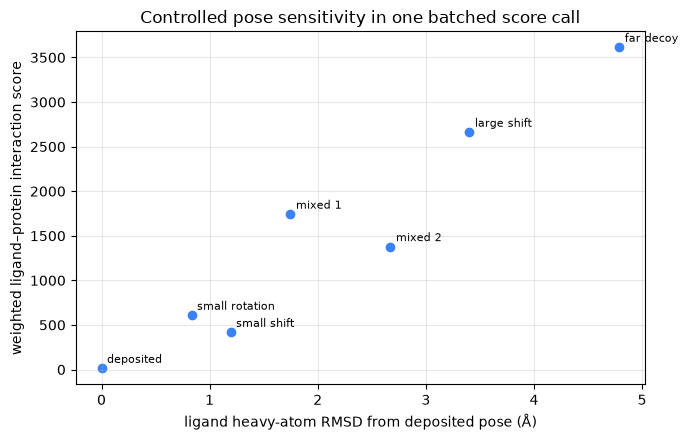
Every decoy preserves the protein and the ligand’s internal geometry. Only the ligand receives a declared rotation about its centroid and translation in the protein frame. These seven states are sensitivity probes, not samples from a docking search distribution.
[4]:
decoy_specs = [
("deposited", 0.0, (0.00, 0.00, 0.00)),
("small rotation", 15.0, (0.25, 0.00, 0.00)),
("small shift", -20.0, (0.00, 0.50, 0.00)),
("mixed 1", 30.0, (0.75, 0.25, 0.00)),
("mixed 2", -45.0, (1.00, 0.50, 0.25)),
("large shift", 60.0, (1.50, 0.00, 0.00)),
("far decoy", 90.0, (2.00, 0.50, 0.00)),
]
ligand_xyz = native_pose.coords[native_ligand_coords]
ligand_center = ligand_xyz.mean(dim=0)
decoy_poses = []
for _, angle_degrees, translation_xyz in decoy_specs:
decoy = native_pose.clone()
angle = torch.as_tensor(
np.deg2rad(angle_degrees),
device=device,
dtype=decoy.coords.dtype,
)
rotation = torch.eye(3, device=device, dtype=decoy.coords.dtype)
rotation[0, 0] = torch.cos(angle)
rotation[0, 1] = -torch.sin(angle)
rotation[1, 0] = torch.sin(angle)
rotation[1, 1] = torch.cos(angle)
translation = torch.as_tensor(
translation_xyz, device=device, dtype=decoy.coords.dtype
)
decoy.coords[native_ligand_coords] = (
(ligand_xyz - ligand_center) @ rotation.T + ligand_center + translation
)
decoy_poses.append(decoy)
decoy_batch = PoseStackBuilder.from_poses(decoy_poses, device)
interaction_scores = ligand_protein_interactions(decoy_batch, score_function).detach()
total_scorer = score_function.render_whole_pose_scoring_module(decoy_batch)
with torch.no_grad():
total_scores = total_scorer(decoy_batch.coords).detach()
ligand_rmsd = ligand_rmsd_from_native(decoy_batch, native_heavy_coords).detach()
decoy_frame = pd.DataFrame(
[
{
"pose_index": pose_index,
"state": label,
"rotation_degrees": angle,
"translation_A": float(np.linalg.norm(translation)),
"ligand_heavy_atom_RMSD_A": float(ligand_rmsd[pose_index].cpu()),
"ligand_protein_interaction_score": float(
interaction_scores[pose_index].cpu()
),
"whole_pose_score": float(total_scores[pose_index].cpu()),
}
for pose_index, (label, angle, translation) in enumerate(decoy_specs)
]
)
show_table(decoy_frame)
fig, axis = plt.subplots(figsize=(7, 4.5))
axis.scatter(
decoy_frame["ligand_heavy_atom_RMSD_A"],
decoy_frame["ligand_protein_interaction_score"],
color="#3b82f6",
)
for row in decoy_frame.itertuples():
axis.annotate(
row.state,
(row.ligand_heavy_atom_RMSD_A, row.ligand_protein_interaction_score),
xytext=(4, 4),
textcoords="offset points",
fontsize=8,
)
axis.set(
xlabel="ligand heavy-atom RMSD from deposited pose (Å)",
ylabel="weighted ligand–protein interaction score",
title="Controlled pose sensitivity in one batched score call",
)
axis.grid(alpha=0.3)
plt.tight_layout()
plt.show()
display(
tmol.switchable_view(
{
label: decoy_batch.split(index)
for index, (label, _, _) in enumerate(decoy_specs)
},
notes={
row.state: (
f"ligand RMSD {row.ligand_heavy_atom_RMSD_A:.2f} Å; "
f"interaction {row.ligand_protein_interaction_score:.2f}"
)
for row in decoy_frame.itertuples()
},
)
)
| Loading ITables v2.9.1 from the internet... (need help?) |
| ⓘpose_index | state | rotation_degrees | translation_A | ligand_heavy_atom_RMSD_A | ligand_protein_interaction_score | whole_pose_score |
|---|---|---|---|---|---|---|
| 0 | deposited | 0.0 | 0.000000 | 0.000000 | 12.211267 | 1099.029663 |
| 1 | small rotation | 15.0 | 0.250000 | 0.832808 | 607.751770 | 1694.570190 |
| 2 | small shift | -20.0 | 0.500000 | 1.193737 | 415.838989 | 1502.657471 |
| 3 | mixed 1 | 30.0 | 0.790569 | 1.747893 | 1741.305176 | 2828.123535 |
| 4 | mixed 2 | -45.0 | 1.145644 | 2.672954 | 1377.491699 | 2464.310303 |
| 5 | large shift | 60.0 | 1.500000 | 3.402579 | 2660.247314 | 3747.066162 |
| 6 | far decoy | 90.0 | 2.061553 | 4.788392 | 3613.181641 | 4699.999512 |
3Dmol.js failed to load for some reason. Please check your browser console for error messages.
3Dmol.js failed to load for some reason. Please check your browser console for error messages.
3Dmol.js failed to load for some reason. Please check your browser console for error messages.
3Dmol.js failed to load for some reason. Please check your browser console for error messages.
3Dmol.js failed to load for some reason. Please check your browser console for error messages.
3Dmol.js failed to load for some reason. Please check your browser console for error messages.
3Dmol.js failed to load for some reason. Please check your browser console for error messages.
The deposited pose has zero displacement by construction. Increasing displacement generally creates steric or solvation penalties in this controlled series, but monotonicity is not guaranteed for arbitrary transformations or complexes. The interaction quantity combines both block-matrix orientations within one bound complex.
Locally minimize three diagnostic states#
The deposited pose, best-scoring non-deposited pose, and worst-scoring non-deposited pose are selected without manual cherry-picking. They are assembled into one batch. Every ligand atom and protein side-chain atom initially within 5 Å of that pose’s ligand may move; protein main-chain atoms remain fixed. A short shared iteration budget is a local response diagnostic, not a converged docking protocol.
[5]:
best_non_native = 1 + int(torch.argmin(interaction_scores[1:]).item())
worst_non_native = 1 + int(torch.argmax(interaction_scores[1:]).item())
selected_indices = [0, best_non_native, worst_non_native]
if len(set(selected_indices)) != 3:
raise RuntimeError("Expected three distinct diagnostic states")
selected = PoseStackBuilder.from_poses(
[decoy_batch.split(index) for index in selected_indices], device
)
selected_labels = [decoy_specs[index][0] for index in selected_indices]
selected_ligand = block_mask_for_name3(selected, LIGAND_NAME)
selected_ligand_coords = res_mask_to_coord_mask(selected, selected_ligand)
selected_sidechains = build_sidechain_coord_mask(selected)
near_ligand = torch.zeros_like(selected.real_atoms)
for pose_index in range(selected.n_poses):
ligand_coords = selected.coords[pose_index, selected_ligand_coords[pose_index]]
distances = (
torch.cdist(selected.coords[pose_index].nan_to_num(), ligand_coords)
.min(dim=1)
.values
)
near_ligand[pose_index] = (
(distances <= 5.0)
& selected_sidechains[pose_index]
& selected.real_atoms[pose_index]
)
movable = selected_ligand_coords | near_ligand
refinement_scorer = score_function.render_whole_pose_scoring_module(selected)
with torch.no_grad():
whole_pose_before = refinement_scorer(selected.coords).detach()
interaction_before = ligand_protein_interactions(selected, score_function).detach()
rmsd_before = ligand_rmsd_from_native(selected, native_heavy_coords).detach()
refined = run_cart_min(
selected,
score_function,
coord_mask=movable,
optimizer_kwargs={"max_iter": 15},
)
if not bool(torch.isfinite(refined.coords[refined.real_atoms]).all()):
raise RuntimeError("Local refinement produced non-finite coordinates")
with torch.no_grad():
whole_pose_after = refinement_scorer(refined.coords).detach()
interaction_after = ligand_protein_interactions(refined, score_function).detach()
rmsd_after = ligand_rmsd_from_native(refined, native_heavy_coords).detach()
refinement_frame = pd.DataFrame(
[
{
"state": label,
"movable_atoms": int(movable[pose_index].sum().item()),
"interaction_before": float(interaction_before[pose_index].cpu()),
"interaction_after": float(interaction_after[pose_index].cpu()),
"interaction_change": float(
(interaction_after[pose_index] - interaction_before[pose_index]).cpu()
),
"whole_pose_before": float(whole_pose_before[pose_index].cpu()),
"whole_pose_after": float(whole_pose_after[pose_index].cpu()),
"whole_pose_change": float(
(whole_pose_after[pose_index] - whole_pose_before[pose_index]).cpu()
),
"ligand_RMSD_before_A": float(rmsd_before[pose_index].cpu()),
"ligand_RMSD_after_A": float(rmsd_after[pose_index].cpu()),
"optimizer_budget": "15-iteration smoke test; convergence not assessed",
}
for pose_index, label in enumerate(selected_labels)
]
)
show_table(refinement_frame)
viewer_states = {}
viewer_notes = {}
for pose_index, label in enumerate(selected_labels):
before_label = f"{label} — before"
after_label = f"{label} — locally minimized"
viewer_states[before_label] = selected.split(pose_index)
viewer_states[after_label] = refined.split(pose_index)
viewer_notes[before_label] = (
f"interaction {float(interaction_before[pose_index].cpu()):.2f}; "
f"ligand RMSD {float(rmsd_before[pose_index].cpu()):.2f} Å"
)
viewer_notes[after_label] = (
f"interaction {float(interaction_after[pose_index].cpu()):.2f}; "
f"ligand RMSD {float(rmsd_after[pose_index].cpu()):.2f} Å; "
f"whole-pose Δ {float((whole_pose_after[pose_index] - whole_pose_before[pose_index]).cpu()):+.2f}"
)
display(tmol.switchable_view(viewer_states, notes=viewer_notes))
| Loading ITables v2.9.1 from the internet... (need help?) |
| ⓘstate | movable_atoms | interaction_before | interaction_after | interaction_change | whole_pose_before | whole_pose_after | whole_pose_change | ligand_RMSD_before_A | ligand_RMSD_after_A | optimizer_budget |
|---|---|---|---|---|---|---|---|---|---|---|
| deposited | 199 | 12.211267 | -20.595383 | -32.806648 | 1099.029785 | 1047.216553 | -51.813232 | 0.000000 | 0.199867 | 15-iteration smoke test; convergence not assessed |
| small shift | 198 | 415.838989 | -7.532748 | -423.371735 | 1502.657471 | 1068.502930 | -434.154541 | 1.193737 | 0.899472 | 15-iteration smoke test; convergence not assessed |
| far decoy | 213 | 3613.181641 | 58.827770 | -3554.353760 | 4699.999512 | 1492.751221 | -3207.248291 | 4.788392 | 4.339905 | 15-iteration smoke test; convergence not assessed |
3Dmol.js failed to load for some reason. Please check your browser console for error messages.
3Dmol.js failed to load for some reason. Please check your browser console for error messages.
3Dmol.js failed to load for some reason. Please check your browser console for error messages.
3Dmol.js failed to load for some reason. Please check your browser console for error messages.
3Dmol.js failed to load for some reason. Please check your browser console for error messages.
3Dmol.js failed to load for some reason. Please check your browser console for error messages.
Local minimization may lower the objective without recovering the deposited pose.
Exercises#
Add rotations around the other two principal axes without changing the native member.
Increase the local minimizer budget and check whether score and geometry stabilize.
Repeat the selected-state refinement with several pocket cutoffs.
Decompose the ligand–protein interaction into weighted score terms.
Construct independent rigid transformations before examining scores, then report rank correlation rather than selecting transformations after inspection.